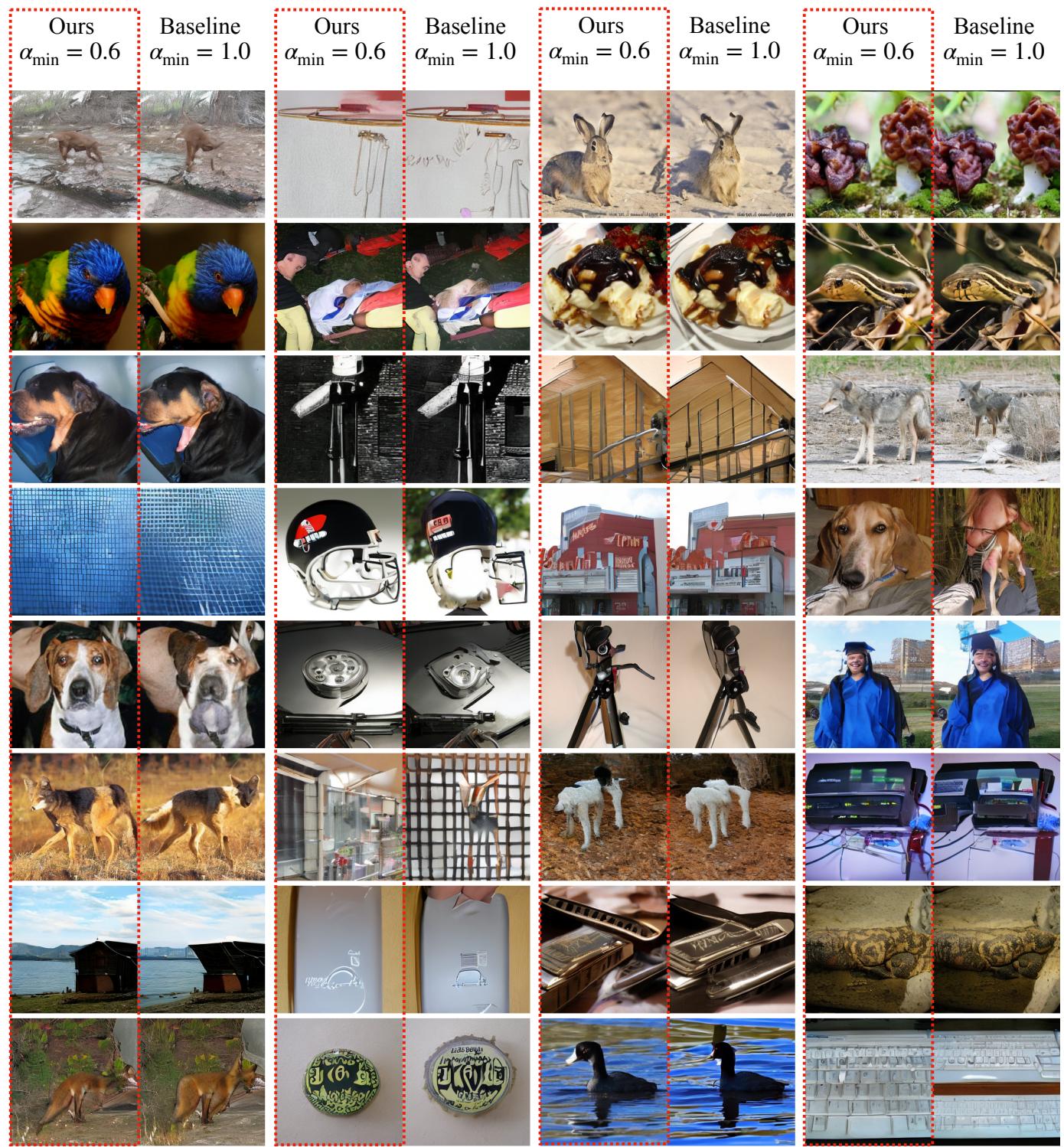
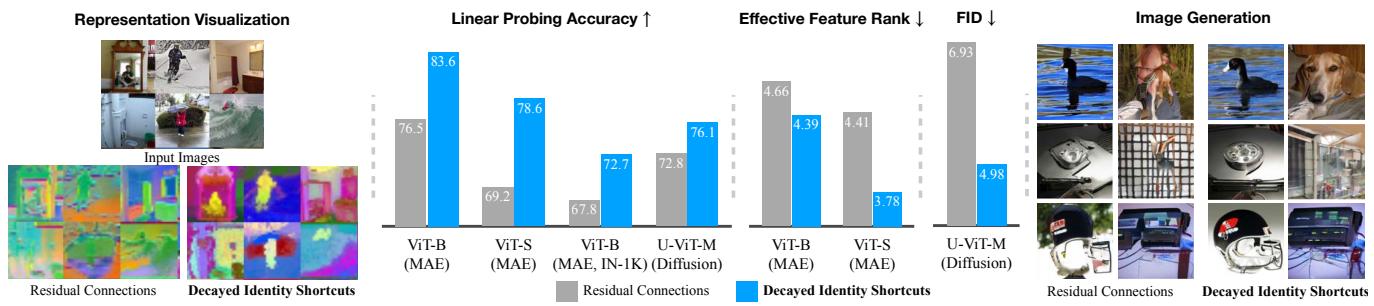
Figureure 8 · Qualitative comparison of images generated by diffusion modelsFigure 8. Qualitative comparison of images generated by diffusion models. Our method, decayed identity shortcuts with $\alpha _ { \mathrm { m i n } } = 0 . 6 ,$ shows improved representation learning and produces higher-quality generated images compared to the baseline, which employs full residual connections $( \alpha _ { \mathrm { m i n } } = 1 . 0 )$ .这张图/表用于判断 Residual Connections Harm Generative Representation 的实验收益来自哪里。重点看替换、消融或跨模型设置下趋势是否一致,而不是只看单个最高分。Figureure 2 · We design decayed identity shortcuts (Figure 1), a variant of residualFigure 2. We design decayed identity shortcuts (Figure 1), a variant of residual connections, to facilitate self-supervised representation learning in generative model. Compared to standard residual connections, our approach yields superior abstract semantic features (left, visualized using Zhang et al. [69]’s approach), whose leading components pop out object instances and classes. Quantitative evaluation shows our architecture encourages lower feature rank and learns better feature representation for both MAE and diffusion models (middle), along with enhanced generation quality for diffusion models (right). These improvements require no additional learnable parameters.这张图概括 Residual Connections Harm Generative Representation 的整体方法流程。阅读时先看模块之间传递的训练信号,再看作者如何把目标拆成可优化的子问题。