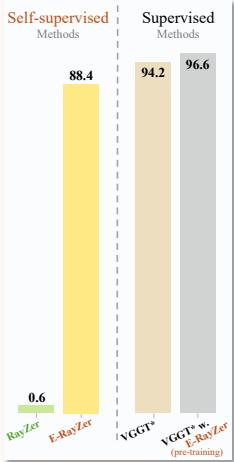
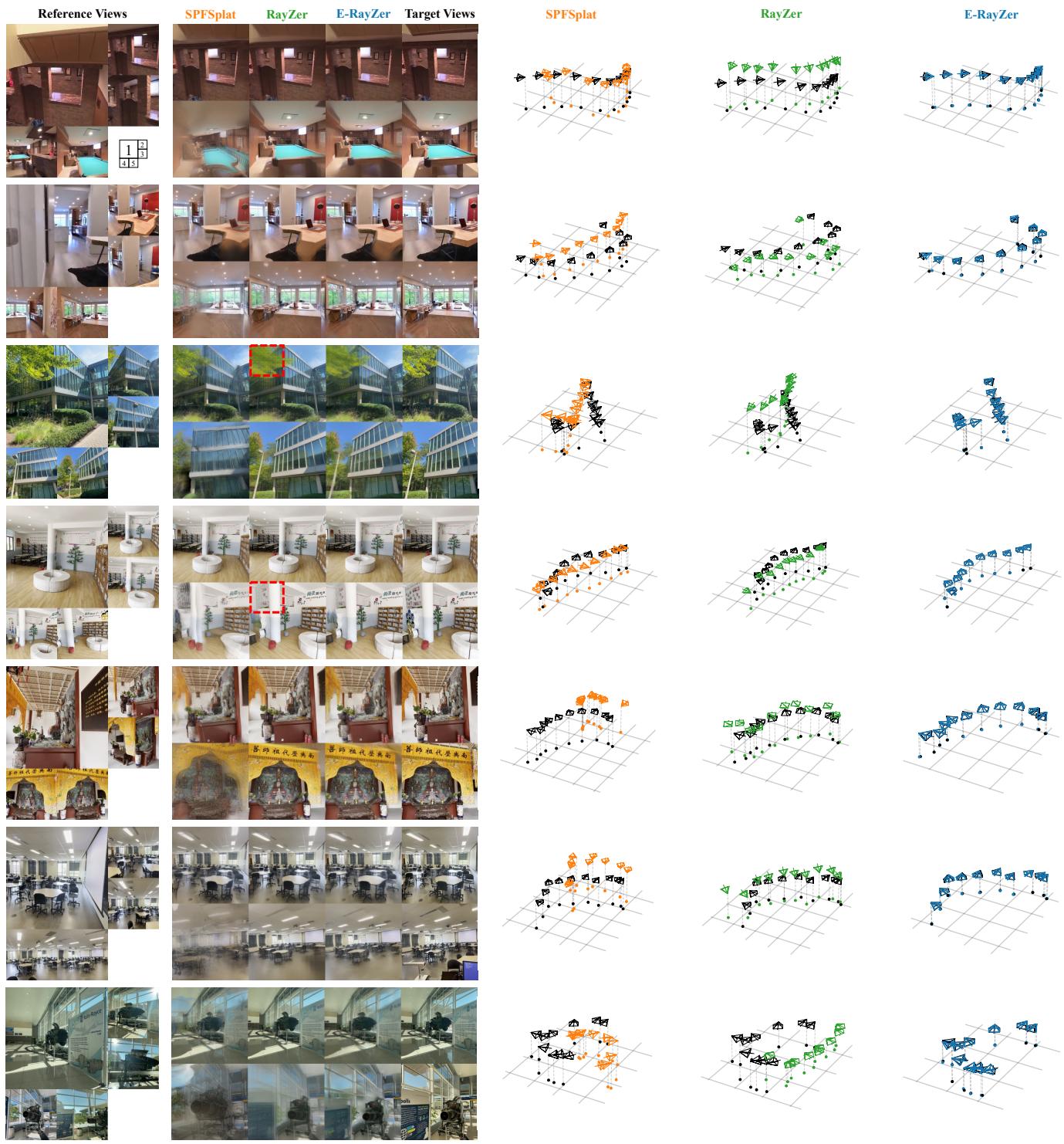
Raw Output Pose AccRaw Output Pose Acc. Figure 1. E-RayZer, a self-supervised 3D vision model that predicts camera poses and scene geometry as 3D Gaussians. The use of explicit 3D geometry yields more geometrically grounded poses compared to its implicit counterpart, RayZer [25]: they are comparable to (and sometimes surpass) those from our supervised baseline, VGGT [59]. Furthermore, E-RayZer serves as a self-supervised visual pretraining framework, with learned representations that transfer effectively to downstream tasks requiring 3D understanding, outperforming previous representation learners such as CroCo v2 [66], VideoMAE V2 [61], DINOv3 [51], and Perception Encoder [7].这张图概括 E-RayZer 的整体方法流程。阅读时先看模块之间传递的训练信号,再看作者如何把目标拆成可优化的子问题。Figureure 6 · Additional Visual Comparison with (Partially) Self-supervised MethodsFigure 6. Additional Visual Comparison with (Partially) Self-supervised Methods. We show results for both novel-view synthesis (left) and pose estimation (right). The temporal order of the reference views is shown in the first row. Ground-truth poses are visualized in black, and predicted poses are aligned to the ground truth via an optimal similarity transform. E-RayZer outperforms baselines in pose accuracy, demonstrating its grounded 3D understanding. While RayZer [25] typically produces high-quality novel views, it often exhibits grid-like artifacts in low-texture regions (highlighted with red boxes; best viewed when zoomed in), likely due to its latent-rendering formulation.这张图/表用于判断 E-RayZer 的实验收益来自哪里。重点看替换、消融或跨模型设置下趋势是否一致,而不是只看单个最高分。