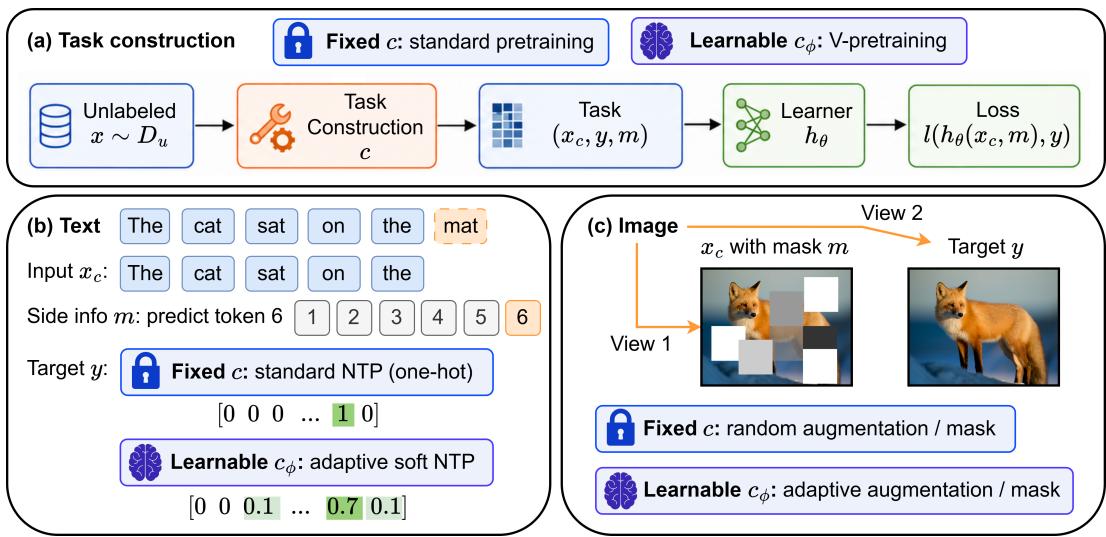
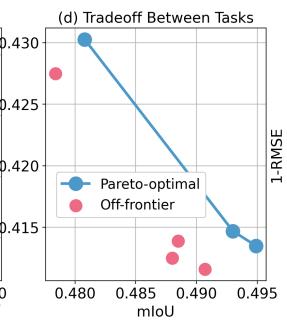
Figureure 1 · : Task construction as the control surface in continued pretrainingFigure 1: Task construction as the control surface in continued pretraining. A construction rule c maps each unlabeled example $x \sim \mathcal { D } _ { u }$ into a self-supervised prediction problem $( x _ { c } , y , m )$ ), such as one-hot next-token prediction in language modeling or paired views and targets in $\mathrm { D I N O - s t y l { \epsilon } }$ vision SSL. Standard continued pretraining fixes this rule before training, whereas V-pretraining replaces it with a feedback-trained designer $c _ { \phi }$ while keeping the learner update self-supervised.这张图来自论文 PDF 的结构化抽取。当前用于辅助理解 Learning What to Predict 的方法或实验,请结合正文精读段落一起看。Figureure 3 · : Additional language diagnosticsFigure 3: Additional language diagnostics. (a): GSM8K Pass@1 as a function of feedback-set size. (b): Pass@k across tested model sizes. (c): token-efficiency diagnostic plotting Pass@1 against unlabeled tokens processed. These curves are diagnostics, not the primary fairness criterion. (d): Tradeoff between segmentation (mIoU) and depth estimation (1-RMSE) induced by varying feedback and task-designer hyperparameters.这张图来自论文 PDF 的结构化抽取。当前用于辅助理解 Learning What to Predict 的方法或实验,请结合正文精读段落一起看。