先说结论。它和通用视觉自监督的关系在于:把 unsupervised object-centric slot attention 从单层 ViT feature 扩展到多层语义融合。 中高相关;详见方法、贡献和实验边界。
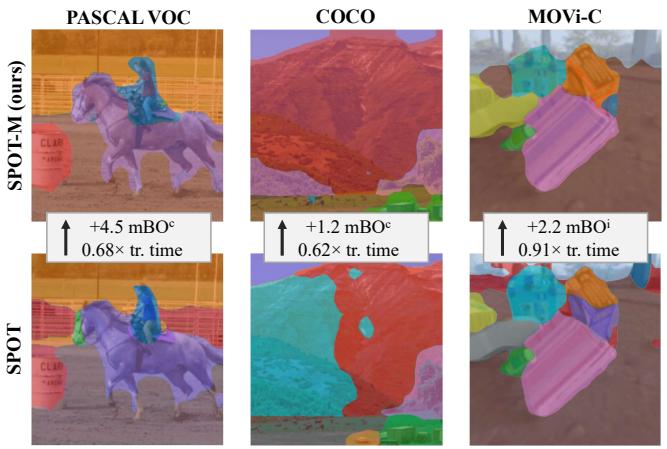
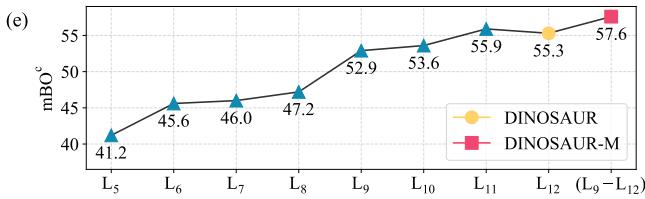
Figureure 1 · MUFASAFigure 1. MUFASA. Our novel framework for slot-based methods leverages multiple feature layers of vision transformers for objectcentric learning. Integrated into the current best model, SPOT [26], we achieve a new state of the art in unsupervised object segmentation on PASCAL VOC, COCO, and MOVi-C, producing high-quality segmentation masks while requiring less time to train.这张图概括 MUFASA 的整体方法流程。阅读时先看模块之间传递的训练信号,再看作者如何把目标拆成可优化的子问题。Figureure 2 · Complementarity of DINO layersFigure 2. Complementarity of DINO layers. (a) PCA visualization for features from layers 4 and 10–12, each encoding varying semantics. (b) Corresponding attention masks from slot attention on these layers, showing different segmentations. (c) Segmentation mask of the single-layer SPOT. (d) The fused slot-attention mask of our SPOT-M captures the person and the dog in a single slot each and follows their boundaries more closely. (e) Gain by combining layers. Blue shows the segmentation accuracy of single-layer DINOSAUR models trained on different encoder layers, yellow is the original DINOSAUR using $\mathrm { L } _ { 1 2 }$ . MUFASA on DINOSAUR combines multiple layers, surpassing all individual ones.这张图/表用于判断 MUFASA 的实验收益来自哪里。重点看替换、消融或跨模型设置下趋势是否一致,而不是只看单个最高分。
核心问题
它和通用视觉自监督的关系在于:把 unsupervised object-centric slot attention 从单层 ViT feature 扩展到多层语义融合。
方法拆解
把 unsupervised object-centric slot attention 从单层 ViT feature 扩展到多层语义融合