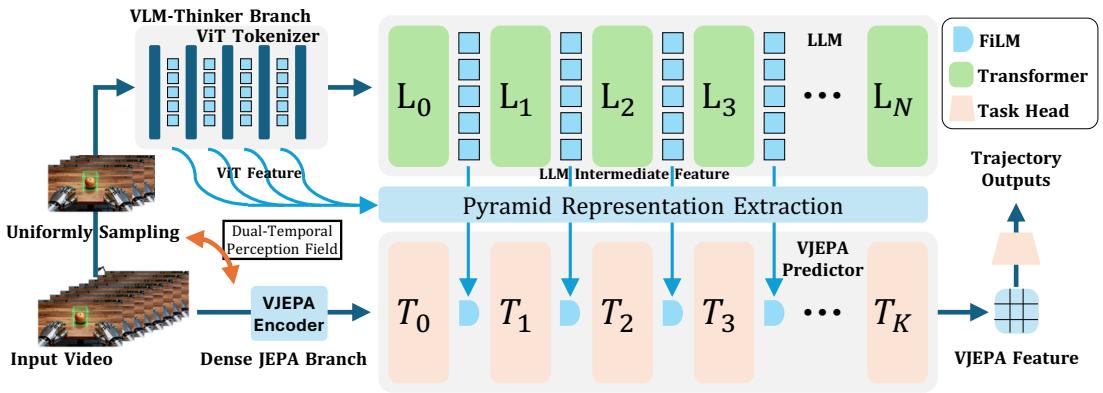
Figureure 1 · : Overall Architecture of ThinkJEPAFigure 1: Overall Architecture of ThinkJEPA. ThinkJEPA couples a dense JEPA branch for fine-grained latent dynamics modeling with a uniformly sampled VLM-thinker branch that provides long-horizon semantic guidance. The VLM guidance—including visual tokens from the ViT visual tokenizer and intermediate hidden states from the language model—is distilled by a pyramidal representation extraction module and injected into the V-JEPA predictor via layer-wise modulation. Concretely, guidance derived from language-model layers $\{ L _ { 0 } , \dots , L _ { N } \}$ is mapped to modulation parameters for predictor layers $\{ T _ { 0 } , \dots , T _ { K } \}$ . The predicted future latents are concatenated with past teacher latents to form the full latent sequence, which is then fed into a task head to produce downstream trajectory predictions.这张图概括 ThinkJEPA 的整体方法流程。阅读时先看模块之间传递的训练信号,再看作者如何把目标拆成可优化的子问题。Figureure 2 · : Qualitative resultsFigure 2: Qualitative results. Predicted future hand-manipulation trajectories visualized as heat maps overlaid on the reference frame. Colors indicate temporal progression from blue (earlier) to red (later). Ideally, trajectories transition smoothly from blue to red, indicating coherent motion over time. ThinkJEPA produces smoother trajectories with better temporal consistency and joint alignment.这张图/表用于判断 ThinkJEPA 的实验收益来自哪里。重点看替换、消融或跨模型设置下趋势是否一致,而不是只看单个最高分。