先说结论。它和通用视觉自监督的关系在于:GenLIP 用语言建模目标预训练 ViT,不走对比 batch 或额外 text decoder,是视觉语言预训练目标的重要更新。 高相关;详见方法、贡献和实验边界。
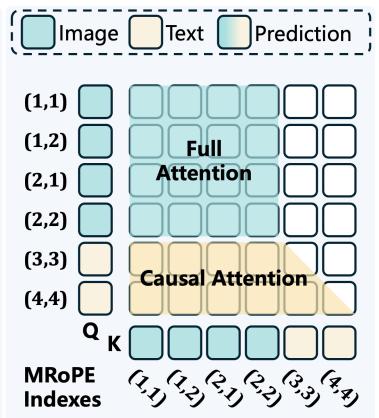
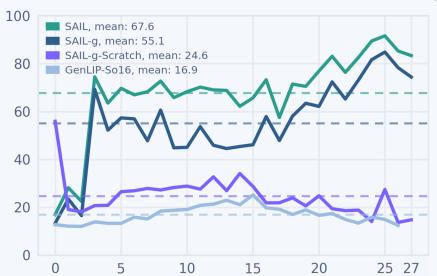
(c) Prefix-LM Attention Figure 2 An overview of the GenLIP framework for simple generative(c) Prefix-LM Attention Figure 2 An overview of the GenLIP framework for simple generative vision-language pretraining. (a) GenLIP Model Architecture: a single Transformer architecture processes a concatenated visual-prefix sequence. The next token prediction is performed exclusively on text tokens via a language modeling head. (b) Gated Attention Layer: the basic layer of GenLIP. The red line in the figure shows the forward path of the gating signal, which is element-wise multiplied with the attention output to control information flow. (c) Prefix-LM Attention Mechanism: image tokens attend bidirectionally, while text tokens attend causally. Multimodal Rotary Position Encoding (MRoPE) injects position information into the query (Q) and key (K) vectors.这张图概括 Let ViT Speak 的整体方法流程。阅读时先看模块之间传递的训练信号,再看作者如何把目标拆成可优化的子问题。(c) Text-to-prompt attention density Figure 10 Layer-wise attention allocation across toke(c) Text-to-prompt attention density Figure 10 Layer-wise attention allocation across token groups. We analyze the attention allocation of generated text tokens over different target token groups with models in Table 9. We report the attention density from generated text tokens to (a) vision tokens, (b) sink tokens (the first two prompt tokens), and (c) prompt tokens. Dashed lines denote the layer-averaged attention densities. The X-axis corresponds to the layer index. Unlike the original SAIL implementation, our implementation does not insert the special tokens ‘<vision>’ and $\scriptstyle \cdot < / { \mathrm { v i s i o n } } > ^ { \prime }$ around the visual patch tokens.这张图/表用于判断 Let ViT Speak 的实验收益来自哪里。重点看替换、消融或跨模型设置下趋势是否一致,而不是只看单个最高分。
核心问题
它和通用视觉自监督的关系在于:GenLIP 用语言建模目标预训练 ViT,不走对比 batch 或额外 text decoder,是视觉语言预训练目标的重要更新。
方法拆解
GenLIP 用语言建模目标预训练 ViT,不走对比 batch 或额外 text decoder,是视觉语言预训练目标的重要更新