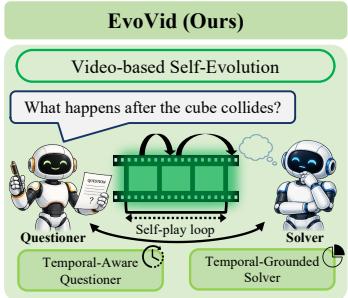
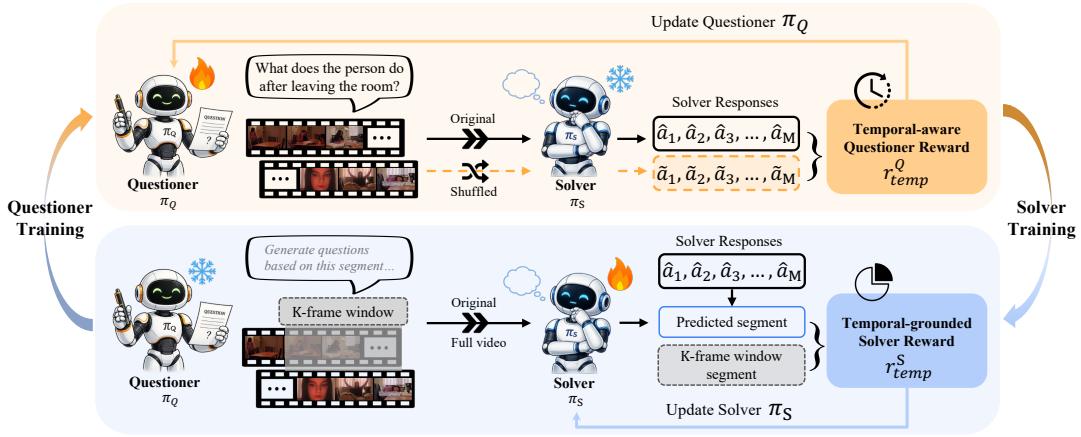
Figureure 1 · : Comparison between supervised RL, VANILLA self-evolving frameworks, Figure 1: Comparison between supervised RL, VANILLA self-evolving frameworks, and EvoVid. Left: Supervised RL relies on human-annotated tasks and solutions to construct reward signals, making training costly and inherently bounded by human expertise. Middle: VANILLA self-evolving frameworks, primarily designed for static modalities, i.e., images, generate generic and often singleframe answerable questions, leading to temporally insensitive Questioner–Solver self-play. Right: EvoVid introduces video-based self-evolution through a temporal-aware Questioner and a temporalgrounded Solver, enabling temporal-centric self-evolution directly from raw, unannotated videos.这张图概括 EvoVid 的整体方法流程。阅读时先看模块之间传递的训练信号,再看作者如何把目标拆成可优化的子问题。Figureure 2 · : Overview of EvoVidFigure 2: Overview of EvoVid. Questioner $\pi _ { Q }$ and Solver $\pi _ { S }$ co-evolve through two temporal-centric rewards. Questioner Training: with original and shuffled frames to derive t $\pi _ { S }$ frozen, tempora $\pi _ { Q }$ generates questions ware Questioner reward $\pi _ { S }$ responds usingolver Training: $r _ { \mathrm { t e m p } } ^ { Q }$ with $\pi _ { Q }$ frozen, the Questioner generates questions from a sampled $K$ -frame window, and $\pi _ { S }$ predicts both the answer and temporal segment, which is compared with the sampled window to derive the temporal-grounded Solver reward $r _ { \mathrm { t e m p } } ^ { S } .$ . Preliminary rewards are omitted for simplicity.这张图概括 EvoVid 的整体方法流程。阅读时先看模块之间传递的训练信号,再看作者如何把目标拆成可优化的子问题。
核心问题
它和通用视觉自监督的关系在于:未标注视频可以通过时间敏感问题生成和片段定位奖励构造自演化训练信号。
方法拆解
temporal-aware questioner reward and temporal-grounded solver reward