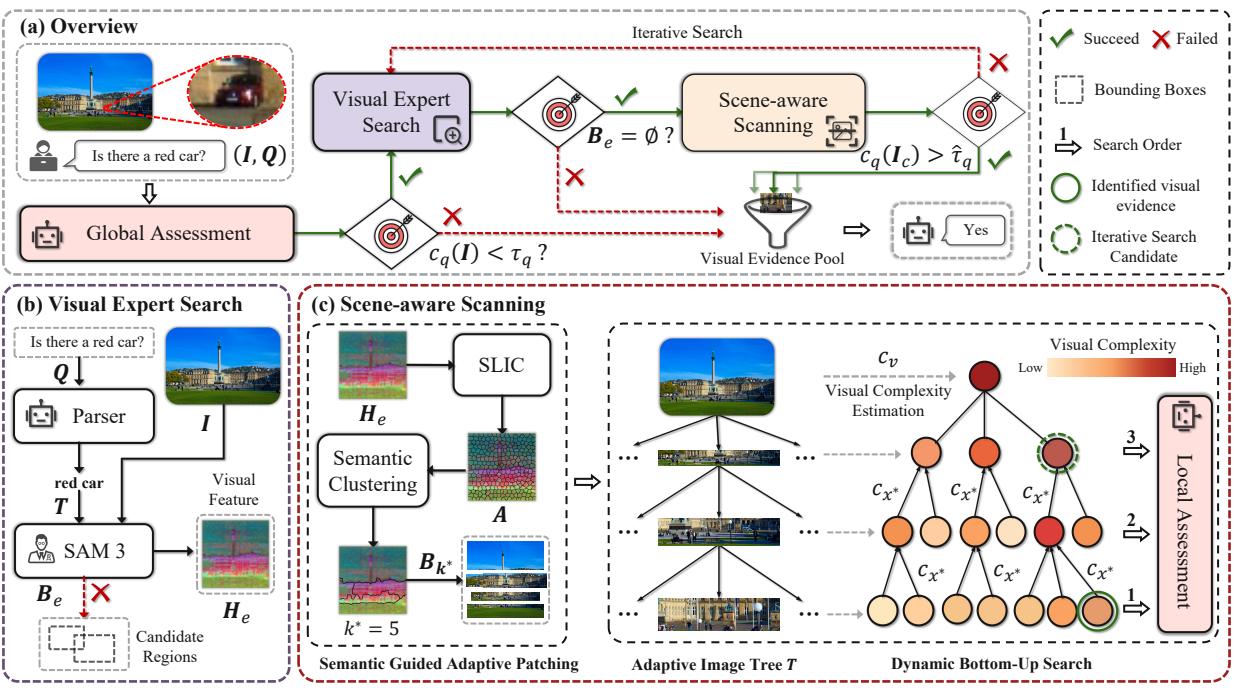
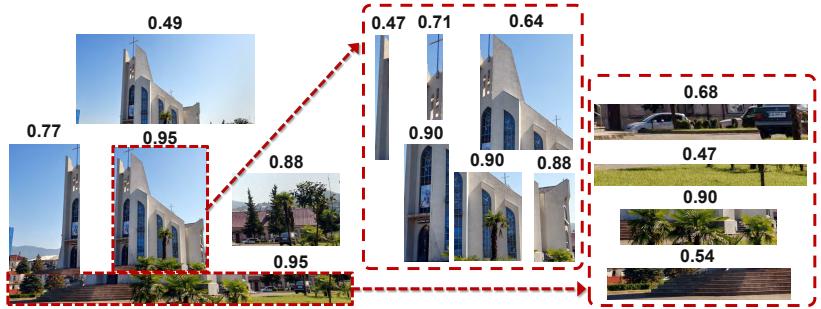
Figureure 2 · Illustration of the CVSearch frameworkFigure 2. Illustration of the CVSearch framework. (a) Workflow. A cognitive Assess-then-Search mechanism triggers Visual Expert Search when global information is insufficient $( c _ { q } < \tau _ { q } )$ . Expert failure (proposals $B _ { e } = \varnothing )$ activates Scene-aware Scanning, which either yields visual evidence upon success or returns the optimal candidate for iterative search upon failure. (b) Visual Expert Search. This module parses queries to prompt a visual expert (SAM 3) for rapid proposals. On failure, extracted visual features are repurposed for the scanning phase. (c) Scene-aware Scanning. Semantic Guided Adaptive Patching partitions images into semantically coherent regions via adaptive clustering. Subsequently, Dynamic Bottom-Up Search prioritizes exploration from leaf nodes and aggregates evidence upwards. If the target remains unconfirmed, the optimal candidate from the first layer guides the next search iteration.这张图概括 CVSearch 的整体方法流程。阅读时先看模块之间传递的训练信号,再看作者如何把目标拆成可优化的子问题。CVSearch (Ours) Figure 7CVSearch (Ours) Figure 7. Visualization of semantic preservation in architectural scenes. Rigid partitioning methods (Zoom Eye and RAP) fragment the continuous structure of the church into disjoint blocks, separating the spire from the nave. CVSearch effectively separates the foreground architecture from the low-complexity sky background (0.49). The annotated values represent Visual Complexity Scores. The adaptive patching respects the building’s geometry, ensuring the main structure is encapsulated within semantically consistent regions.这张图概括 CVSearch 的整体方法流程。阅读时先看模块之间传递的训练信号,再看作者如何把目标拆成可优化的子问题。