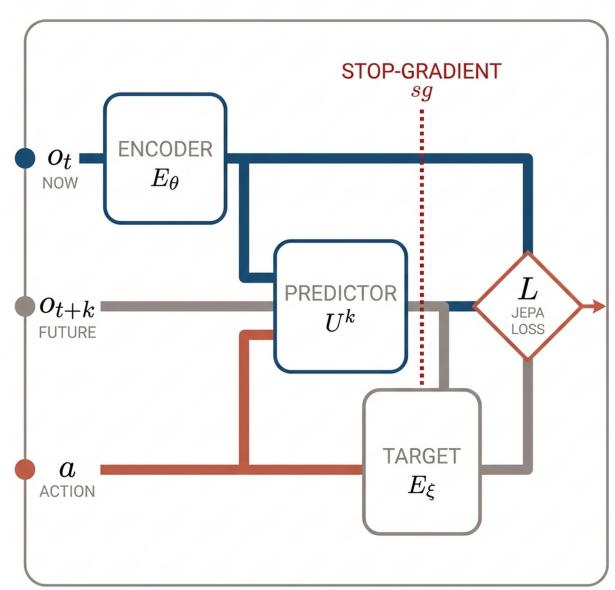
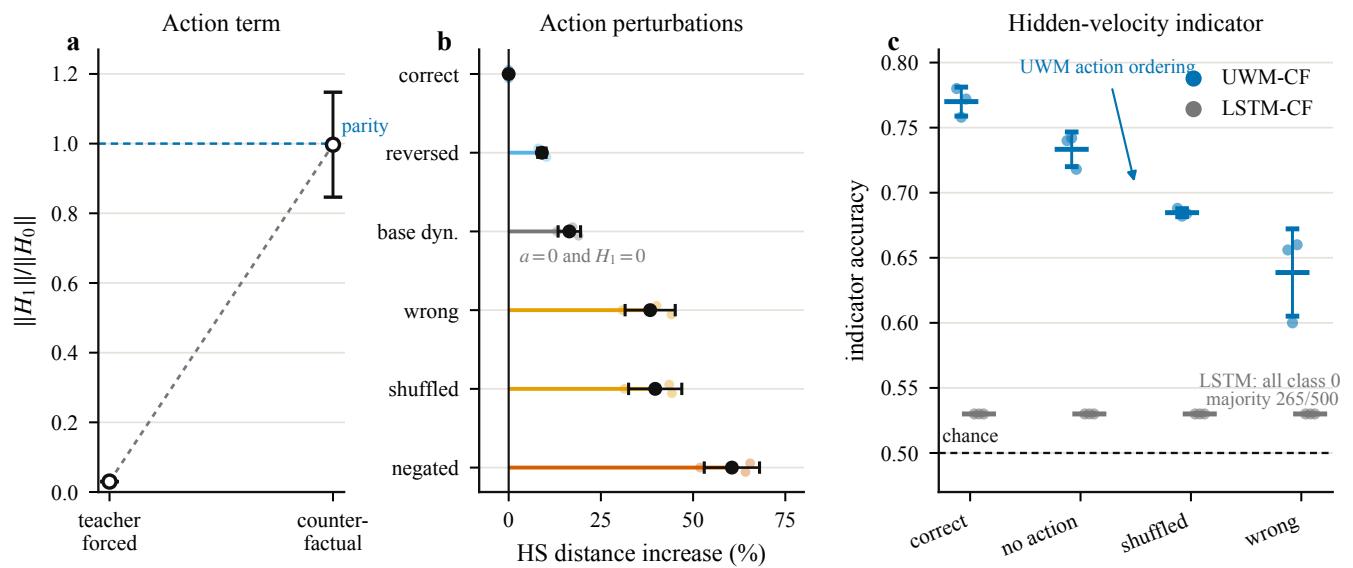
(b) Architecture: JEPA scaffold with unitary predictor(b) Architecture: JEPA scaffold with unitary predictor. Figure 1 From point latents to belief-structured imagination, and the architecture that realises it. (a) A standard vector-latent JEPA predicts a point in representation space. UWM-JEPA instead represents the latent as a density matrix and rolls it forward on an isospectral orbit. Under partial observability this gives the predictor a structured latent in which uncertainty and hidden modes can be carried through blind rollout; actions steer the unitary trajectory through $H ( a ) = H _ { 0 } + a H _ { 1 }$ . (b) The online encoder maps the current observation history to $\mid \rho _ { t } ;$ ; the predictor applies $U ^ { k } \rho _ { t } ( U ^ { \dagger } ) ^ { k }$ or an action-conditioned sequence $U ( a _ { t + k - 1 } ) \cdot \cdot \cdot U ( a _ { t } ) \rho _ { t } U ( a _ { t } ) ^ { \dagger } \cdot \cdot \cdot U ( a _ { t + k - 1 } ) ^ { \dagger }$ . The EMA target encoder supplies the stop-gradient future target, and the JEPA loss is evaluated after the system readout and projection.这张图概括 UWM-JEPA 的整体方法流程。阅读时先看模块之间传递的训练信号,再看作者如何把目标拆成可优化的子问题。Figureure 2 · Action-binding evidenceFigure 2 Action-binding evidence. A: teacher-forced JEPA makes the action Hamiltonian nearly inert, while counterfactual targets recover an action term comparable to the base dynamics. B: action perturbation controls increase Hilbert–Schmidt distance to the counterfactual target. C: the hidden-velocity indicator is solved above chance by UWM-JEPA-CF, while the matched LSTM-JEPA-CF main-comparison configuration collapses to majority-class predictor.这张图/表用于判断 UWM-JEPA 的实验收益来自哪里。重点看替换、消融或跨模型设置下趋势是否一致,而不是只看单个最高分。