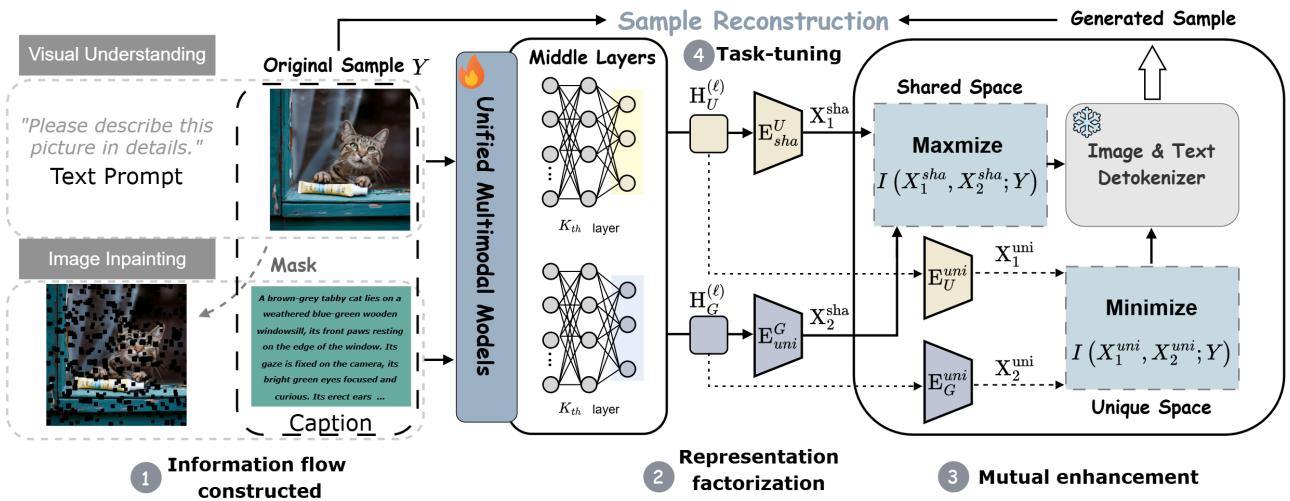
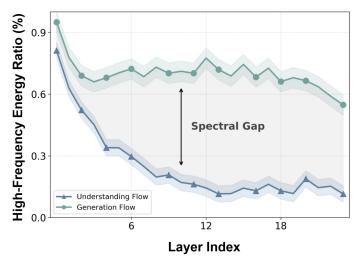
Figureure 3 · Overview of the self-improved mutual reinforcement (DIVA) pipelineFigure 3. Overview of the self-improved mutual reinforcement (DIVA) pipeline. We propose a post-training paradigm that explicitly align the shared information, while preserve the integrity of unique information between the understanding and generation flows. Both flows are constructed base on the same sample pair to ensure the shared anchor.这张图概括 DIVA 的整体方法流程。阅读时先看模块之间传递的训练信号,再看作者如何把目标拆成可优化的子问题。(c)Frequency Analysis Figure 2(c)Frequency Analysis Figure 2. Visualization of the representation divergence and synergy. (a) shows the severe conflicts occurs in the shallow and deep layers while the mitigation is observed in the middle layers. Meantime, based on the two information flows that are described in Sec. 3.1, the effective rank between different flows increases in the middle layers and decrease again in the deep layers as presented in (b). And we conduct a frequency analysis in (c) to explore the distinct preferences for information extraction and modeling between understanding and generation branches. The discovery of these phenomena forms the basis of DIVA.这张可视化用来解释 DIVA 学到的中间表征或对齐关系。重点看它是否支持正文里的机制判断。