先说结论。它和通用视觉自监督的关系在于:在 3D reconstruction 模型特征空间做 diffusion denoising,体现“修特征而非修像素”的路线。 中相关;详见方法、贡献和实验边界。
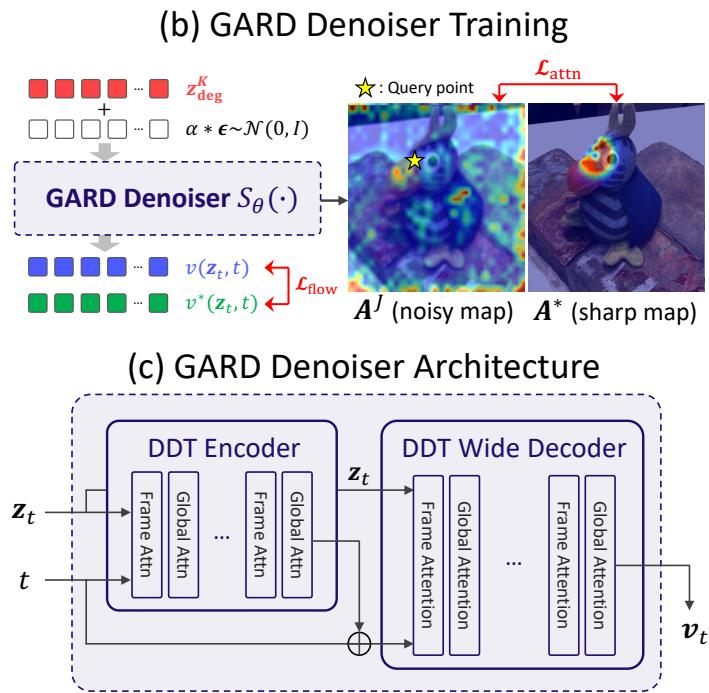
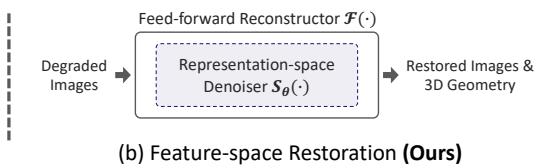
Figureure 3 · : Overview of the GARD frameworkFigure 3: Overview of the GARD framework. (a) The GARD denoiser $ { \boldsymbol { S } } _ { \theta } ( \cdot )$ is learned within the representation space of a frozen multi-view encoder [29] to restore degraded intermediate representations $\mathbf { z } _ { \mathrm { d e g } } ^ { K }$ into restored representations $\mathbf { z } _ { \mathrm { r e s } } ^ { K }$ before they are propagated through the remaining encoder layers. The restored representations $\mathcal { Z } _ { \mathrm { r e s } }$ are then decoded by their respective decoders to produce geometry predictions and restored RGB images. (b) The GARD denoiser is optimized using an interpolated flow matching loss together with an attention alignment loss, which jointly learns the mapping from degraded to clean feature representations while preserving geometric consistency through explicit alignment of attention maps. (c) The GARD denoiser adopts a multi-view latent diffusion architecture [71], comprising a DDT encoder [60] and a DDT wide decoder, with global attention layers inserted to enable multi-view modeling, thereby facilitating global context aggregation and reconstruction of high-dimensional multi-view representations.这张图概括 Geometry-Aware Representation Denoising for Robust 的整体方法流程。阅读时先看模块之间传递的训练信号,再看作者如何把目标拆成可优化的子问题。Figureure 2 · : Comparison of restoration denoising spacesFigure 2: Comparison of restoration denoising spaces. (a) A restore-then-reconstruct pipeline first performs pixel-space restoration prior to 3D reconstruction. However, performing restoration in a single-view setting [69, 6, 5] or within a heavily compressed VAE-based latent space [34, 23] fails to preserve cross-view consistency and fine-grained geometric details, which often results in suboptimal geometric reconstruction. (b) In contrast, our Geometry-Aware Representation Denoising (GARD) operates on geometry-aware latent representations within a feed-forward reconstruction model, enabling the joint recovery of restored images and consistent 3D geometry across views.这张图概括 Geometry-Aware Representation Denoising for Robust 的整体方法流程。阅读时先看模块之间传递的训练信号,再看作者如何把目标拆成可优化的子问题。
核心问题
它和通用视觉自监督的关系在于:在 3D reconstruction 模型特征空间做 diffusion denoising,体现“修特征而非修像素”的路线。
方法拆解
在 3D reconstruction 模型特征空间做 diffusion denoising,体现“修特征而非修像素”的路线