先说结论。它和通用视觉自监督的关系在于:提出 Video LLM 内部存在可复用 token interface,用未配对单模态数据对齐新模态到视频 token 流形。 高相关;详见方法、贡献和实验边界。
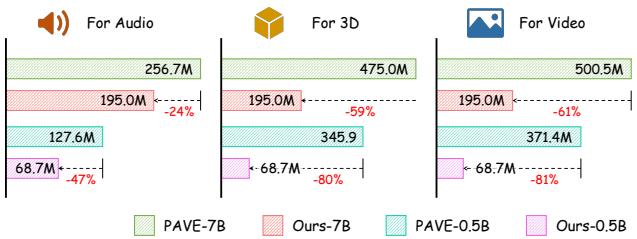
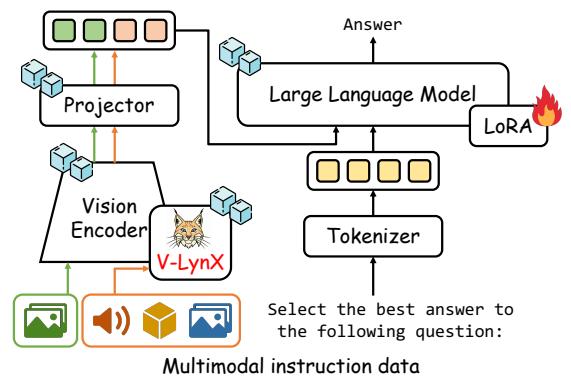
(a) Performance comparisons across 9 multimodal tasks (b) Extra number of parameters for e(a) Performance comparisons across 9 multimodal tasks (b) Extra number of parameters for each new modality Figure 1. V-LynX enables efficient modality expansion of pretrained Video LLMs. (a) V-LynX achieves state-of-the-art performance across diverse multimodal benchmarks with audio, 3D, and additional video, while (b) requiring significantly fewer extra parameters than PAVE (Liu et al., 2025).这张图/表用于判断 V-LynX 的实验收益来自哪里。重点看替换、消融或跨模型设置下趋势是否一致,而不是只看单个最高分。(c) Instruction tuning Figure 3(c) Instruction tuning Figure 3. Overall framework of our V-LynX. (a) We first extract interface guidance from a set of available videos and (b) learn LoRAs in the vision encoder to adapt the interface to given new modality data through attention response alignment and distribution regularization. (c) We then train additional LoRAs in the LLM on diverse instruction datasets.这张图概括 V-LynX 的整体方法流程。阅读时先看模块之间传递的训练信号,再看作者如何把目标拆成可优化的子问题。
核心问题
它和通用视觉自监督的关系在于:提出 Video LLM 内部存在可复用 token interface,用未配对单模态数据对齐新模态到视频 token 流形。
方法拆解
提出 Video LLM 内部存在可复用 token interface,用未配对单模态数据对齐新模态到视频 token 流形