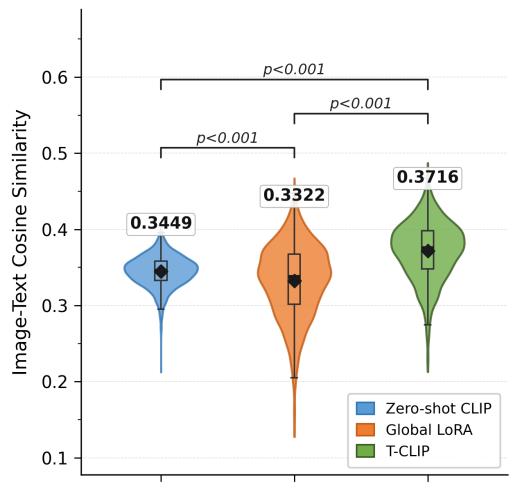
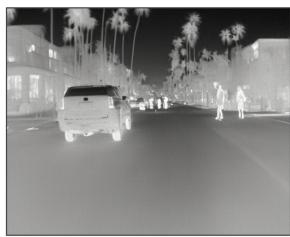
Image-text cosine similarity between matched thermal imagecaption pairs measures how well Image-text cosine similarity between matched thermal imagecaption pairs measures how well each model aligns a thermal image with its correct description in embedding space. Zero-shot CLIP (cosine similarity = 0.3449) shows insufficient thermal image-text alignment, resulting in negligible retrieval performance (R@1 = 0.003). Standard LoRA fine-tuning of CLIP on thermal data (Global LoRA) shows a marginal drop in cosine similarity (0.3449 → 0.3322) compared to zero-shot CLIP, reflecting instability when adapting a model trained on RGB data to the thermal domain, using only generic scene descriptions without explicit thermal supervision. T-CLIP, through decoupled dual-context alignment on physics-aware captions, achieves the strongest alignment (0.3716), corresponding to a 26× improvement in R@1 (0.003 → 0.078; Table 1). All pairwise differences are statistically significant $( p \ll 0 . 0 0 1$ , Welch t-test, n = 2252); p-values are unchanged after Benjamini-Hochberg correction (FDR = 0.05), confirming robustness to multiple comparison adjustment (appendix section A.1). Figure 1: Mean image-text cosine similarity of matched thermal image-caption pairs on the KAIST test set (Hwang et al., 2015) (n = 2252), reflecting the thermal perception gap in standard CLIP (Radford et al., 2021) and T-CLIP’s improvement.这张图/表用于判断 T-CLIP 的实验收益来自哪里。重点看替换、消融或跨模型设置下趋势是否一致,而不是只看单个最高分。FLIR Dataset Figure 11: Generated thermal image samples using captions from KAIST (Hwang eFLIR Dataset Figure 11: Generated thermal image samples using captions from KAIST (Hwang et al., 2015), FLIR (FLIR Systems, 2025), and FMB (Liu et al., 2023). For each prompt, left: zero-shot SDXL (standard CLIP text encoder); right: T-CLIP + SDXL. The T-CLIP + SDXL model captures both global scene context and fine-grained object-level heat signatures.这张图来自论文 PDF 的结构化抽取。当前用于辅助理解 T-CLIP 的方法或实验,请结合正文精读段落一起看。