先说结论。它和通用视觉自监督的关系在于:直接分析自监督 ViT 注意力定位的逆 scaling 现象,并用小模型定位 + 大模型嵌入做无训练增强。 高相关;详见方法、贡献和实验边界。
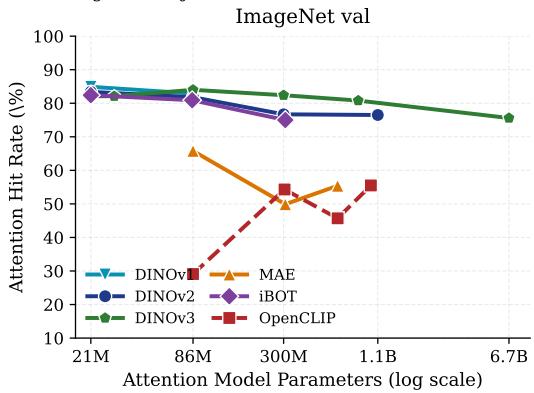
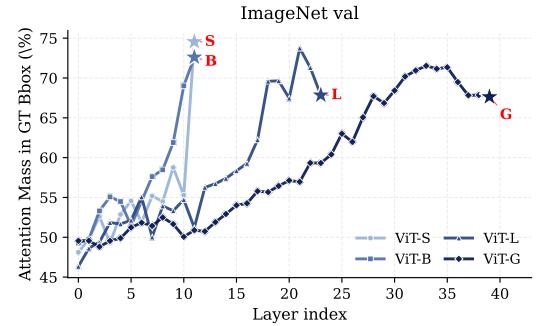
Figureure 11 · : Attention hit rate vsFigure 11: Attention hit rate vs. model size across six pretraining families, on Waterbirds (left) and ImageNet val (right). Hit rate is the fraction of images where the arg max of the attention map falls inside the ground-truth bounding box. The DINOv2 and DINOv3 families show the cleanest inversescaling trend; MAE drops sharply from ViT-B/16 to ViT-L/16 on Waterbirds; OpenCLIP (dashed) breaks the trend, with ViT-B/16 at 0.166 on Waterbirds (well below the next size). Companion to Figure 2; see Table 3 for precise values.这张图/表用于判断 $A^2$ 的实验收益来自哪里。重点看替换、消融或跨模型设置下趋势是否一致,而不是只看单个最高分。Figureure 9 · : Per-layer CLS-to-patches attention mass for DINOv2 with register tokFigure 9: Per-layer CLS-to-patches attention mass for DINOv2 with register tokens [8]. Stars mark each model’s last block (the layer used in our other figures). ViT-S and ViT-B peak at the last block; ViT-L peaks at block 21 of 24 and ViT-G at block 32 of 40, dropping 12–13 points on Waterbirds (left) and 4–6 points on ImageNet val (right) by the final block. Larger ViTs’ final blocks drift away from foreground localization while smaller ViTs concentrate localization in their last block. Appendix Figure 13 shows the same plot for DINOv2 without registers; per-layer hit-rate counterparts are in Appendix Figures 12 and 14.这张可视化用来解释 $A^2$ 学到的中间表征或对齐关系。重点看它是否支持正文里的机制判断。
核心问题
它和通用视觉自监督的关系在于:直接分析自监督 ViT 注意力定位的逆 scaling 现象,并用小模型定位 + 大模型嵌入做无训练增强。
方法拆解
直接分析自监督 ViT 注意力定位的逆 scaling 现象,并用小模型定位 + 大模型嵌入做无训练增强