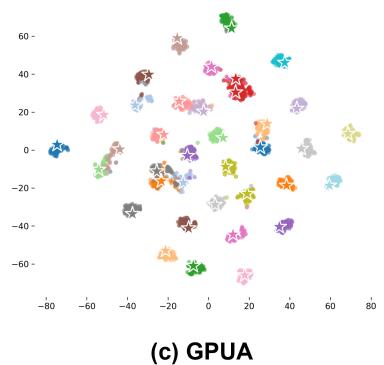
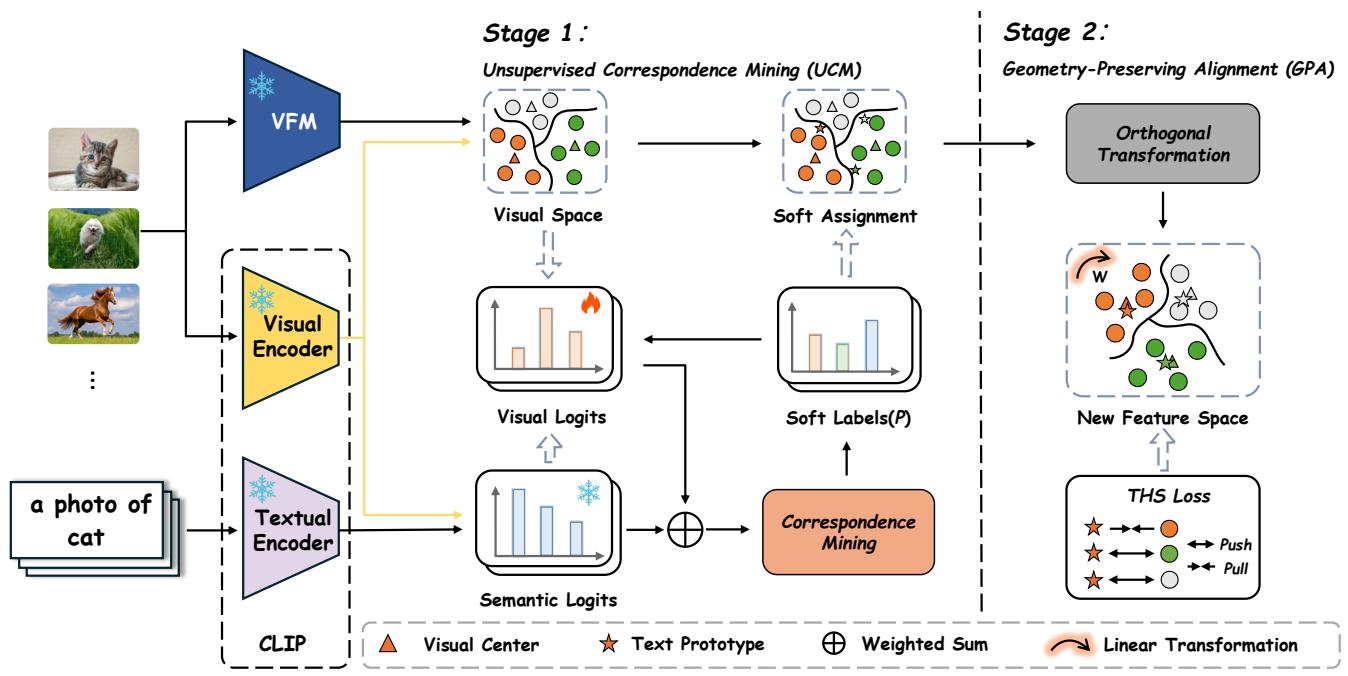
Figureure 1 · t-SNE visualization of foundation-model representations on the PetsFigure 1. t-SNE visualization of foundation-model representations on the Pets. (a) The original CLIP space exhibits a pronounced modality gap between image-text embeddings. (b) VFM features yield more compact intra-class clusters, yet lack globally consistent alignment to semantic concepts. (c) GPUA (Ours) projects visual clusters onto their corresponding semantic anchors (⋆) while preserving intra-class structure, demonstrating effective geometry-preserving alignment and recovering accurate instance-to-prototype correspondences.这张可视化用来解释 Geometry-Preserving Unsupervised Alignment for Heterogeneous 学到的中间表征或对齐关系。重点看它是否支持正文里的机制判断。Figureure 2 · The pipeline of GPUAFigure 2. The pipeline of GPUA. Stage 1: An unsupervised correspondence estimation module infers soft assignments (P) by jointly enforcing structural consistency and semantic alignment between visual features and semantic prototypes. Stage 2: These correspondences are used to derive the optimal orthogonal transformation (W), which is further refined via the THS loss to yield a hubness-robust embedding space.这张图概括 Geometry-Preserving Unsupervised Alignment for Heterogeneous 的整体方法流程。阅读时先看模块之间传递的训练信号,再看作者如何把目标拆成可优化的子问题。