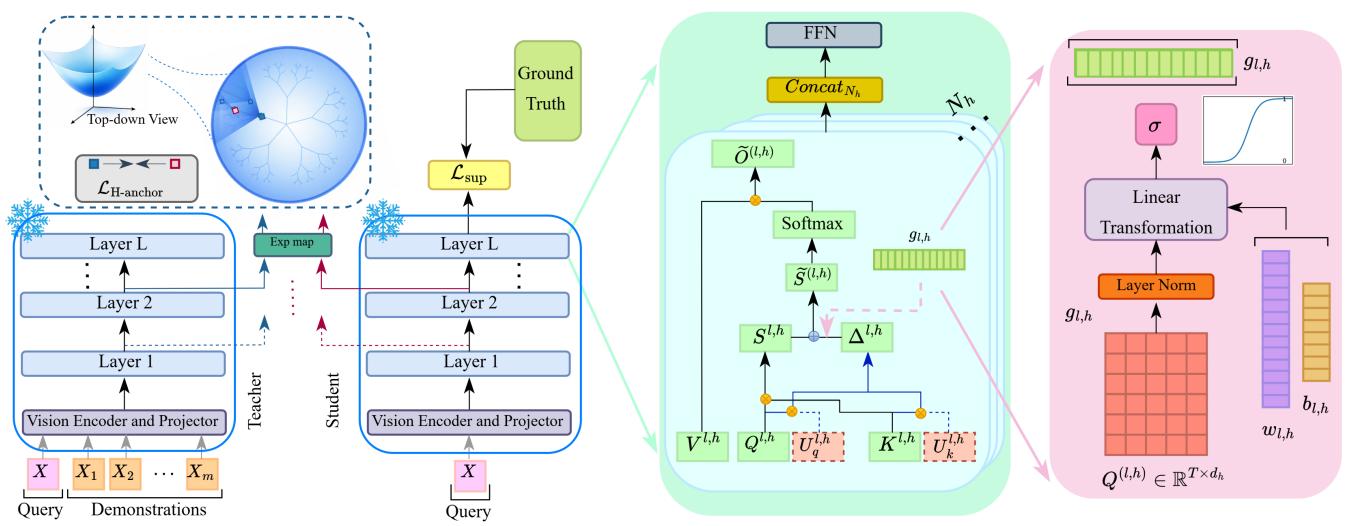
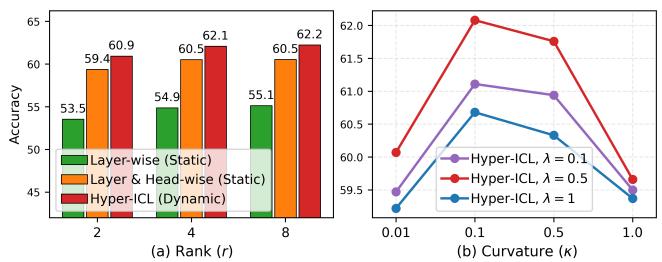
Figureure 1 · Overview of Hyper-ICLFigure 1. Overview of Hyper-ICL. A frozen teacher processes the full demonstration-conditioned prompt, while the student receives only the query at inference time. Hyper-ICL reconstructs demonstration effects by calibrating attention through a parameter-efficient low-rank logit-level adapter, whose strength is controlled token-wise by a query-adaptive gate $^ { g _ { l , h } }$ across layers and heads. A layer-wise hyperbolic anchor distillation loss further aligns intermediate student features to the teacher in Lorentz space via geodesic distance, preserving the demonstration–query relationships for demonstration-free inference.这张图概括 Hyper-ICL 的整体方法流程。阅读时先看模块之间传递的训练信号,再看作者如何把目标拆成可优化的子问题。Figureure 3 · Ablation of Hyper-ICL hyperparameters and architectural choices on IdeFigure 3. Ablation of Hyper-ICL hyperparameters and architectural choices on Idefics-9B (VQAv2). (a) Effect of the low-rank adapter rank r for logit-level attention calibration, comparing static interventions (layer-wise, layer & head-wise) with our queryadaptive token-wise modulated Hyper-ICL. (b) Sensitivity of the hyperbolic anchor distillation to curvature κ and the supervision weight λ, showing the best performance at $\kappa = 0 . 1$ and λ = 0.5.这张图/表用于判断 Hyper-ICL 的实验收益来自哪里。重点看替换、消融或跨模型设置下趋势是否一致,而不是只看单个最高分。