Learning Geometric Representations from Videos:它和通用视觉自监督的关系在于:GeoVR 用纯 2D video 与 3D foundation teacher 重塑 MLLM 几何表征,是今天最强的视频/空间表征候选
高相关;详见方法、贡献和实验边界。
Learning Geometric Representations from Videos for Spatial Intelligent Multimodal Large Language Models arXiv 原文链接
编号2606.05833优先级P0类别Visual SSL / representation会议arXiv方法GeoVR 用纯 2D video 与 3D foundation teacher 重塑 MLLM 几何表征,是今天最强的视频/空间表征候选来源arXiv / OpenReview
先说结论。它和通用视觉自监督的关系在于:GeoVR 用纯 2D video 与 3D foundation teacher 重塑 MLLM 几何表征,是今天最强的视频/空间表征候选。 高相关;详见方法、贡献和实验边界。
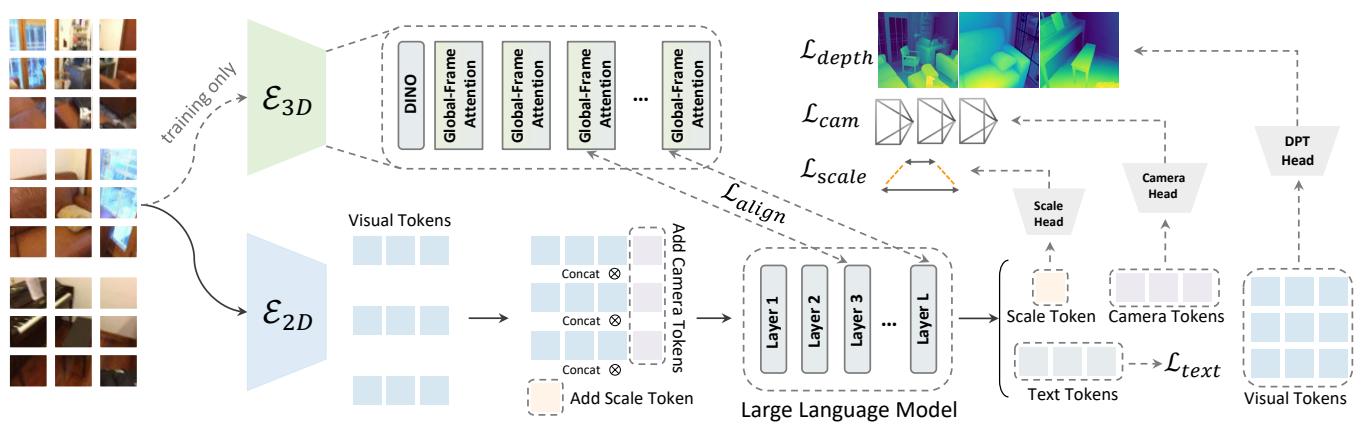
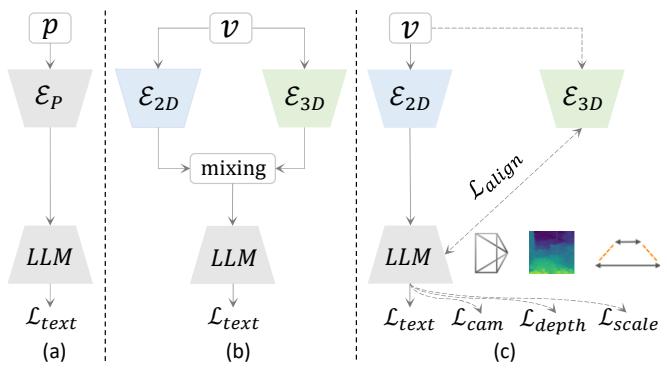
Figureure 2 · Framework of GeoVRFigure 2. Framework of GeoVR. During training, alongside the standard next-token prediction $( \mathcal { L } _ { t e x t } )$ , the intrinsic latent space is restructured via: camera pose estimation $( \mathcal { L } _ { c a m } )$ , dense depth prediction $( \mathcal { L } _ { d e p t h } )$ , metric scale calibration $( \mathcal { L } _ { s c a l e } )$ , and geometric representation alignment $( \mathcal { L } _ { a l i g n } )$ from a frozen 3D teacher $( \mathcal { E } _ { 3 D } )$ . All auxiliary heads and the $\mathcal { E } _ { 3 D }$ branch are discarded during inference.这张图概括 Learning Geometric Representations from Videos 的整体方法流程。阅读时先看模块之间传递的训练信号,再看作者如何把目标拆成可优化的子问题。Figureure 1 · Comparison of different paradigmsFigure 1. Comparison of different paradigms. P and V denote point clouds and RGB video. $\mathcal { E } _ { P } , \mathcal { E } _ { 2 D } ,$ , and $\mathcal { E } _ { 3 D }$ denote point cloud, 2D vision, and 3D foundation encoders, respectively. (a) relies on scarce 3D data, limiting scalability. (b) patches external 3D features onto 2D tokens, causing inference overhead. (c) (ours) restructures the latent space via training-only geometric constraints.这张图/表用于判断 Learning Geometric Representations from Videos 的实验收益来自哪里。重点看替换、消融或跨模型设置下趋势是否一致,而不是只看单个最高分。
核心问题
它和通用视觉自监督的关系在于:GeoVR 用纯 2D video 与 3D foundation teacher 重塑 MLLM 几何表征,是今天最强的视频/空间表征候选。
方法拆解
GeoVR 用纯 2D video 与 3D foundation teacher 重塑 MLLM 几何表征,是今天最强的视频/空间表征候选