先说结论。它和通用视觉自监督的关系在于:MGSD 用符号状态 teacher 做训练期特权监督,改善纯视觉推理中的 state recovery 与多步规划。 中高相关;详见方法、贡献和实验边界。
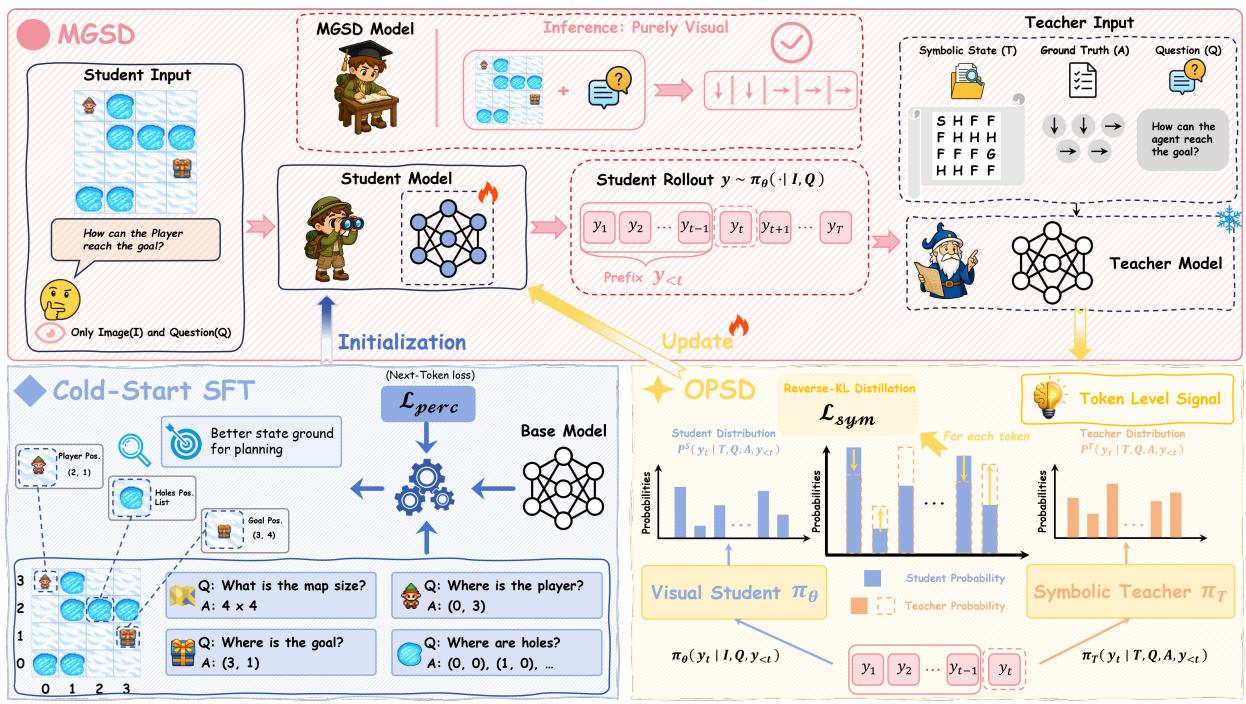
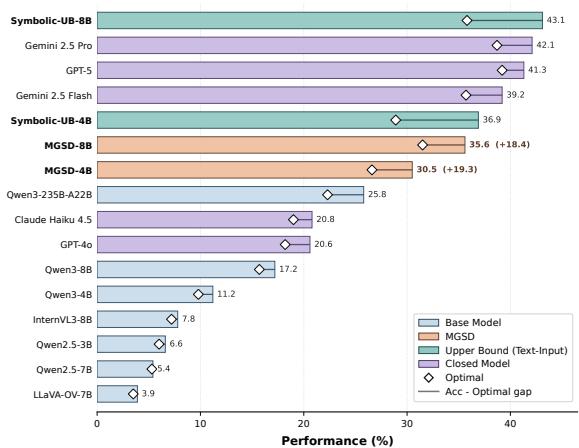
Figureure 2 · : Overview of the MGSD frameworkFigure 2: Overview of the MGSD framework. Training consists of two stages to bridge the perception–reasoning modality gap. Bottom Left (Cold-Start SFT): The base visual model is fine-tuned on structured perception tasks to reliably recover state variables (e.g., coordinates of the player, goal, and holes) from images. Bottom Right (OPSD): Symbolic-guided on-policy self-distillation. The visual student generates reasoning rollouts from the image (I), while a privileged symbolic teacher conditions on the explicit symbolic state (T ) and reference plan (A) to provide dense, token-level supervision on the student’s prefix. Top (Inference): The symbolic teacher is discarded, and the trained student performs spatial planning purely from visual inputs.这张图概括 Learning Visual Spatial Planning from 的整体方法流程。阅读时先看模块之间传递的训练信号,再看作者如何把目标拆成可优化的子问题。Figureure 3 · : Overall Performance on Visual Spatial PlanningFigure 3: Overall Performance on Visual Spatial Planning. MGSD significantly boosts the capabilities of the Qwen3 base models, outperforming several much larger open-source and proprietary VLMs. Diamond markers denote optimal-path accuracy, illustrating the gap between overall task success and perfect reasoning. Symbolic-input models serve as oracle references.这张图/表用于判断 Learning Visual Spatial Planning from 的实验收益来自哪里。重点看替换、消融或跨模型设置下趋势是否一致,而不是只看单个最高分。
核心问题
它和通用视觉自监督的关系在于:MGSD 用符号状态 teacher 做训练期特权监督,改善纯视觉推理中的 state recovery 与多步规划。
方法拆解
MGSD 用符号状态 teacher 做训练期特权监督,改善纯视觉推理中的 state recovery 与多步规划