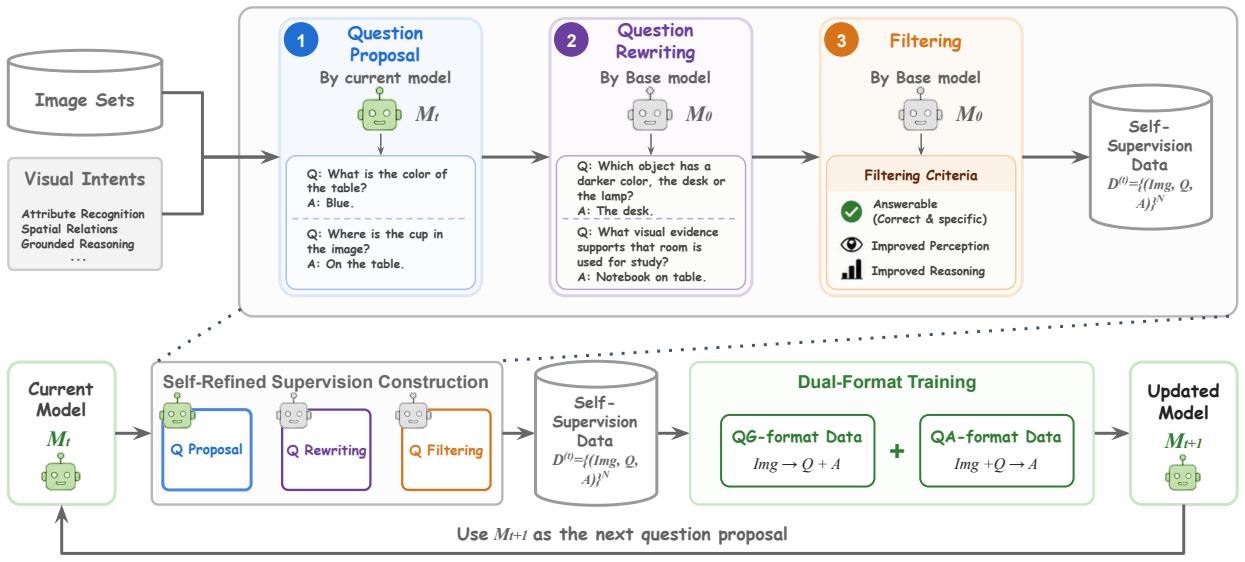
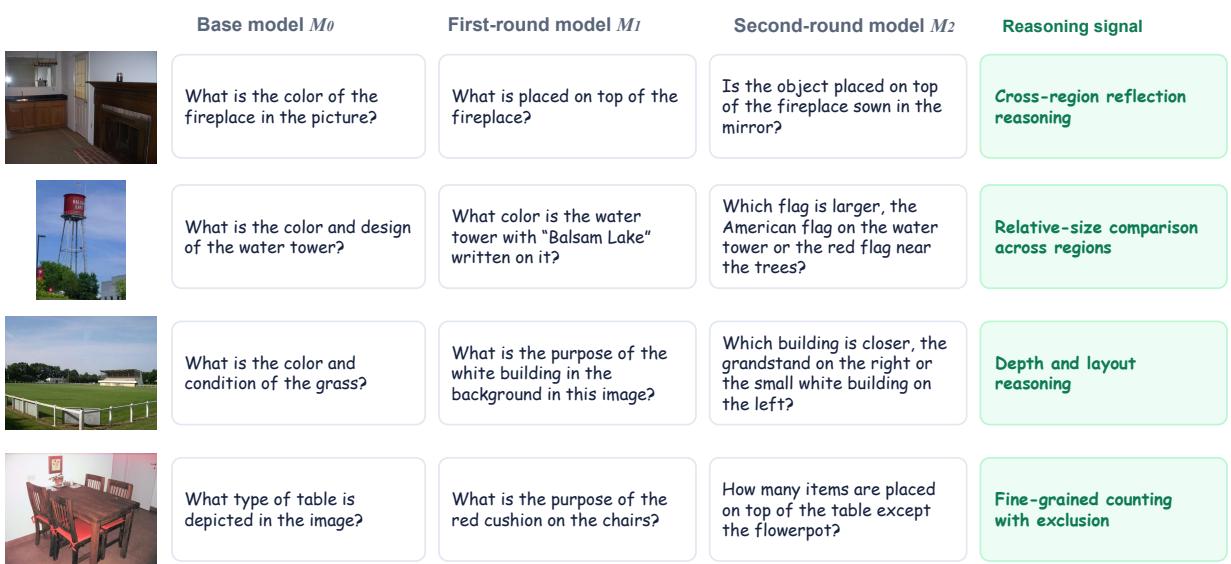
Figureure 1 · : Overview of our self-evolving visual questioner frameworkFigure 1: Overview of our self-evolving visual questioner framework. Given unlabeled image sets and visualintent prompts, the current model $M _ { t }$ first proposes candidate questions. A stable base model $M _ { 0 }$ then rewrites and filters these proposals to construct self-supervision data $\mathcal { D } ^ { ( t ) }$ with improved answerability, perception difficulty, and reasoning difficulty. The refined supervision is used for dual-format training with both QG-format and QA-format objectives, producing an updated model $M _ { t + 1 }$ . The updated model is reused as the proposer in the next round, forming an iterative self-improvement loop.这张图概括 Self-Evolving Visual Questioner 的整体方法流程。阅读时先看模块之间传递的训练信号,再看作者如何把目标拆成可优化的子问题。Figureure 9 · : Qualitative examples of question improvement across generation roundFigure 9: Qualitative examples of question improvement across generation rounds. We compare questions generated by the base model $M _ { 0 } ,$ the first-round model M1, and the second-round model M2 on the same images. The base model often asks shallow recognition questions about colors, object types, or scene categories. After iterative generation and training, the generated questions become more visually grounded and require stronger reasoning signals, such as cross-region reflection reasoning, relative-size comparison, depth/layout understanding, and fine-grained counting with exclusion.这张图/表用于判断 Self-Evolving Visual Questioner 的实验收益来自哪里。重点看替换、消融或跨模型设置下趋势是否一致,而不是只看单个最高分。