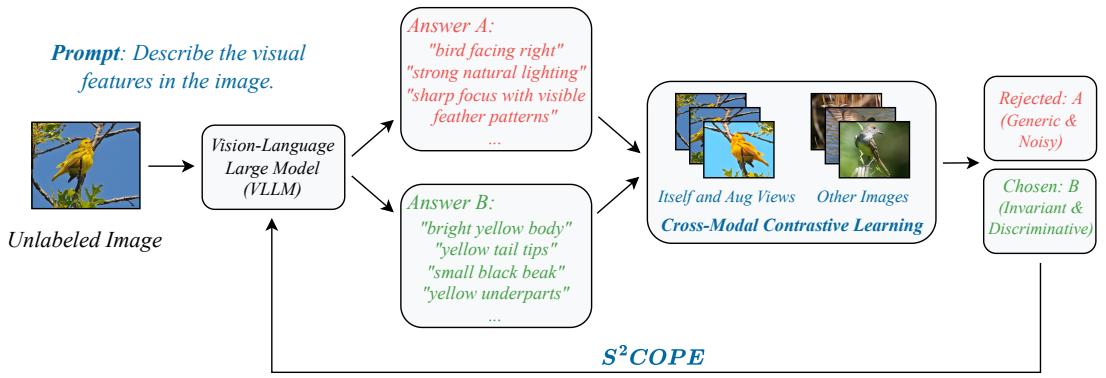
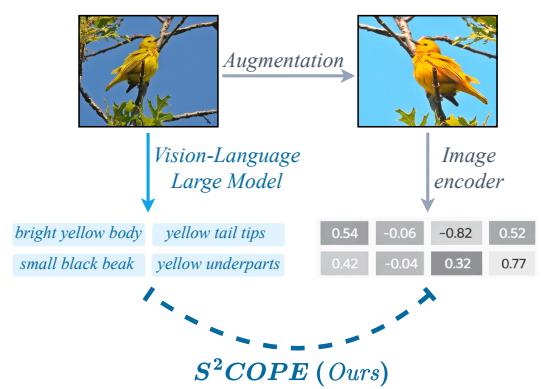
Figureure 2 · : Overview of the $\mathbf { S ^ { 2 } C O P E }$ Discovery LoopFigure 2: Overview of the $\mathbf { S ^ { 2 } C O P E }$ Discovery Loop. Our framework operates as an end-toend, self-supervised discovery process. In iteration k, the VLLM policy $\pi _ { k }$ uses high-temperature sampling to hypothesize diverse candidate concepts $C ( x )$ for an unlabeled image x. To evaluate these proposals without human labels, we compute a self-supervised, cross-modal contrastive reward $R ( c , x )$ based on visual invariance. A candidate concept receives a high reward only if it is stable across augmented views (the positive set) while maintaining specificity against unrelated batch images. This automatically filters out generic, noisy descriptions (Answer $\mathbf { A } )$ in favor of discriminative, structured attributes (Answer B). An Easy-Negative pairing strategy (selecting pairs with the largest reward gap) converts these rewards into preference pairs $( c _ { w } , c _ { l } )$ to form dataset $\mathcal { D } _ { k }$ . Finally, Direct Preference Optimization (DPO) internalizes this invariance by updating the VLLM concept generator’s weights, yielding a refined policy $\pi _ { k + 1 }$ that iteratively transforms the VLLM into a self-supervised concept miner.这张图概括 S$^2$COPE 的整体方法流程。阅读时先看模块之间传递的训练信号,再看作者如何把目标拆成可优化的子问题。Figureure 1 · : Self-Supervised Visual Concept DiscoveryFigure 1: Self-Supervised Visual Concept Discovery. (Left) Standard contrastive learning yields discriminative but opaque, high-dimensional feature vectors that act as uninterpretable "black boxes." (Right) In contrast, $\mathbf { \bar { S } } ^ { 2 } \mathbf { \bar { C } } \mathbf { O P E }$ discovers explicitly interpretable concepts $( \mathrm { e . g . }$ , "bright yellow body") directly from unannotated images. By utilizing Vision-Large-Language Models as a broad semantic prior, our self-supervised preference optimization loop grounds raw visual features into discrete, human-readable attributes, yielding transparent representations that improve classification accuracy on unseen data.这张图/表用于判断 S$^2$COPE 的实验收益来自哪里。重点看替换、消融或跨模型设置下趋势是否一致,而不是只看单个最高分。