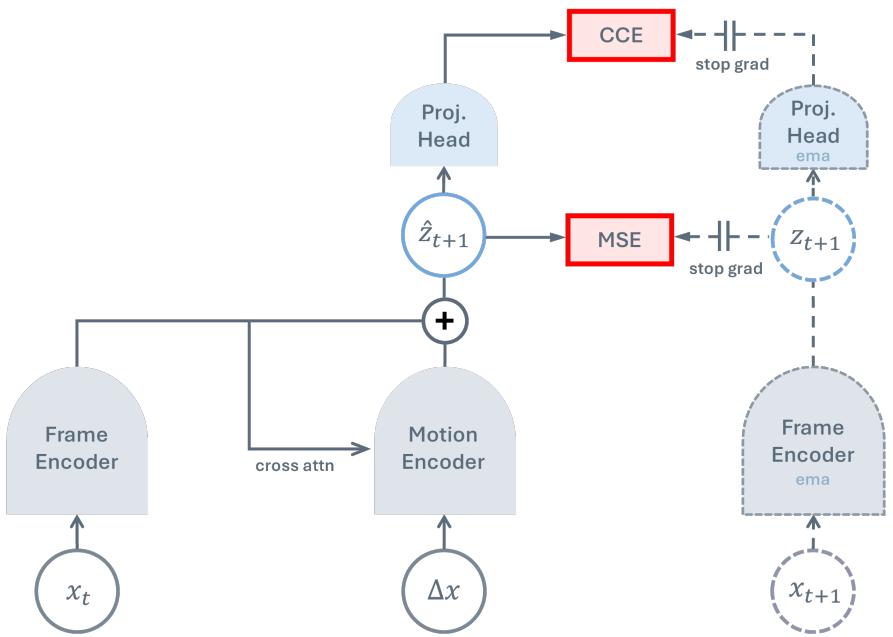
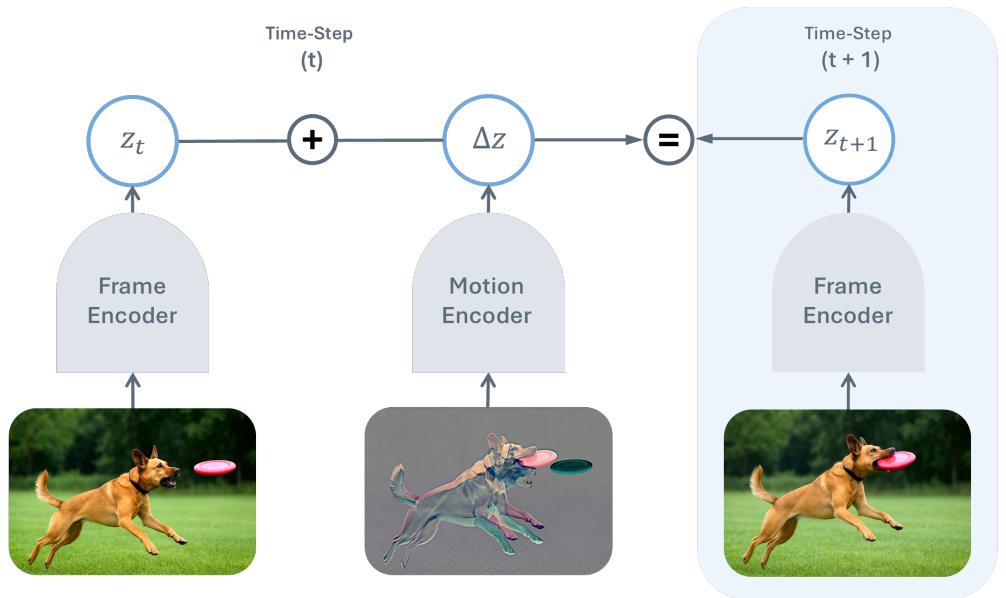
Figureure 2 · : TDV ArchitectureFigure 2: TDV Architecture. TDV predicts the next frame’s representation by adding a learned motion vector to the current frame’s representation. Left (student): the frame encoder embeds the current frame, while the motion encoder turns the raw pixel difference between frames into a latent motion shift, conditioned on the current frame via cross-attention. Their sum is the predicted representation of the next frame. Right (teacher): an EMA copy of the frame encoder embeds the true next frame to supply the target. Two losses act on the prediction: a mean-squared error on the representations enforces the causal next-frame constraint, and a DINO-style [17] cross-entropy on the projection heads prevents collapse. Stop-gradients block the teacher from receiving gradients. Figure style inspired by [25, 26].这张图概括 You Don't Need Strong Assumptions 的整体方法流程。阅读时先看模块之间传递的训练信号,再看作者如何把目标拆成可优化的子问题。Figureure 1 · : TDV Frame and Motion Encoding IntuitionFigure 1: TDV Frame and Motion Encoding Intuition. TDV learns to encode frames such that the current frame’s representation, when added to a learned motion encoding, predicts the next frame’s representation. Because video has high temporal consistency, the raw RGB pixel difference between frames is intrinsically lower rank than the frames themselves, shown here as the edge outlines of a dog and a frisbee. The motion encoder compresses these high-dimensional RGB differences into abstract motion-level features.这张图来自论文 PDF 的结构化抽取。当前用于辅助理解 You Don't Need Strong Assumptions 的方法或实验,请结合正文精读段落一起看。