NEST: Narrative Event Structures in Time for Long Video Understanding arXiv 新增 + long video benchmark 原文链接
编号2606.19706优先级P2类别arXiv 新增 + long video benchmark会议arXiv 新增 + long video benchmark方法以电影级长视频事件结构测试模型是否理解跨时间叙事,而不只是 needle retrieval来源arXiv / OpenReview
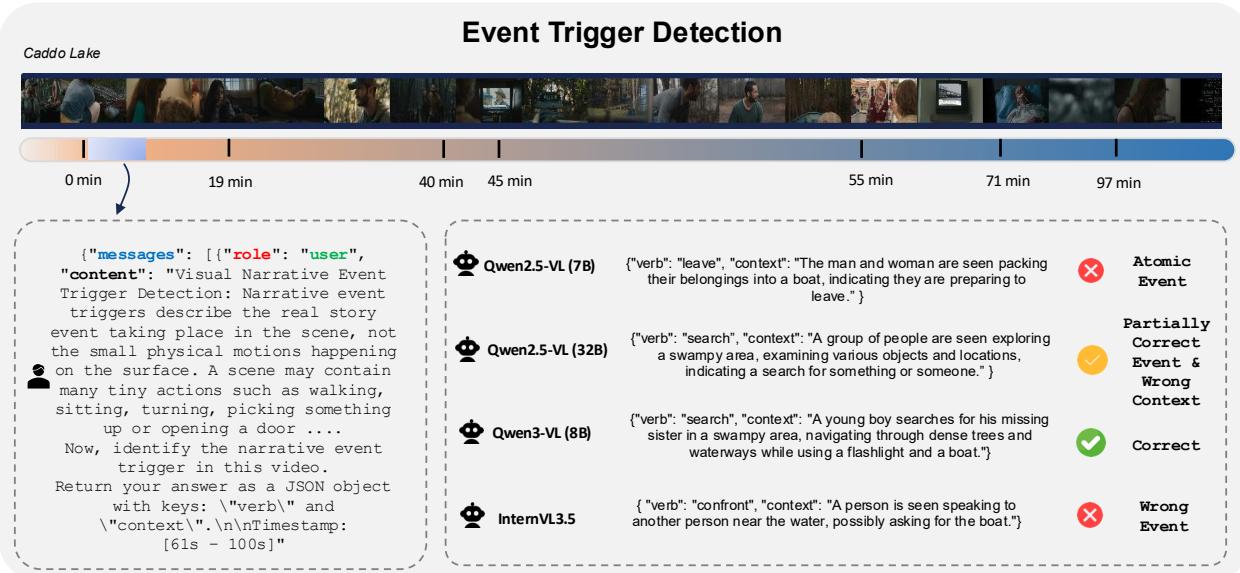
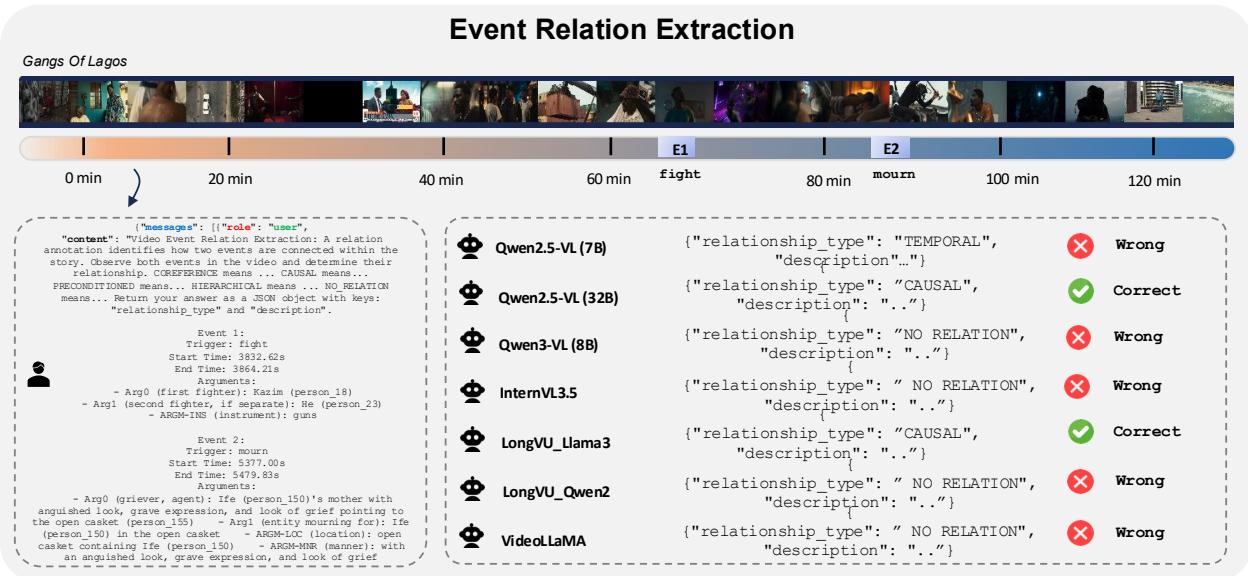
Figureure 12 · : Event Trigger Detection example from Caddo Lake (97 min)Figure 12: Event Trigger Detection example from Caddo Lake (97 min). Given the scene between 61–100 seconds, models must identify the narrative event trigger. Only Qwen3-VL (8B) correctly predicts “search” with accurate context describing the narrative situation. Qwen2.5-VL (32B) identifies the correct trigger (“search”) but provides a generic context that misses the specific narrative details. Qwen2.5-VL (7B) predicts “leave,” an atomic-level event describing surface-level physical actions (packing belongings into a boat) rather than the underlying narrative event. InternVL3.5 predicts an entirely wrong event (“confront”), misinterpreting the scene content. This example illustrates the spectrum of ETD failure modes: atomic verb defaults that miss narrative meaning, correct triggers with insufficient context, and wholly incorrect event predictions.这张图来自论文 PDF 的结构化抽取。当前用于辅助理解 NEST 的方法或实验,请结合正文精读段落一起看。Figureure 11 · : Event Relation Extraction example from Gangs of Lagos (120 min)Figure 11: Event Relation Extraction example from Gangs of Lagos (120 min). A “fight” event (E1, near 60 min) is followed by a “mourn” event (E2, near 80 min), with the ground-truth relation being CAUSAL. Only Qwen2.5- VL (32B) and LongVU-LLaMA3 correctly identify the causal link. Qwen2.5-VL (7B) predicts TEMPORAL, recognizing the sequential ordering but missing the causal dependency. The remaining four models predict NO\_RELATION, failing to connect the two events despite their relative temporal proximity (∼20 minutes apart). This example highlights that even when events are not separated by extreme temporal gaps, most models still struggle to infer narrative causality from video content.这张图来自论文 PDF 的结构化抽取。当前用于辅助理解 NEST 的方法或实验,请结合正文精读段落一起看。