先说结论。它和通用视觉自监督的关系在于:直接在视觉 feature space 做 test-time correction,提醒 VLM 鲁棒性不应只调 prompt。 中相关;详见方法、贡献和实验边界。
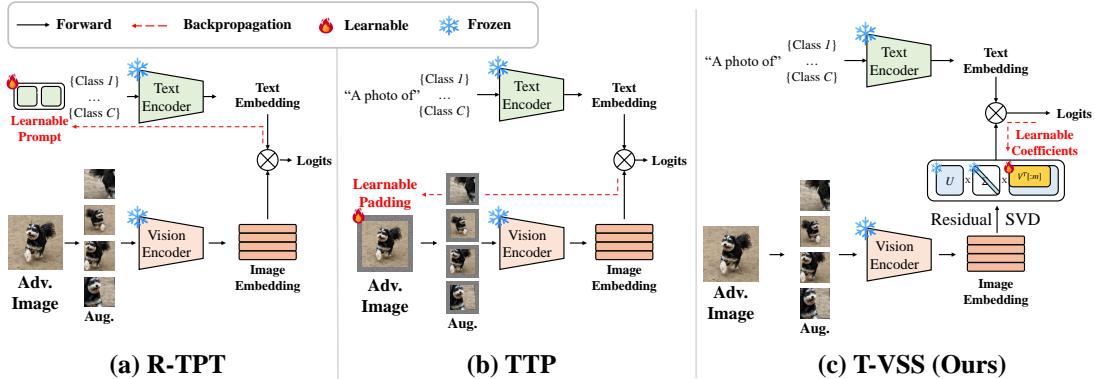
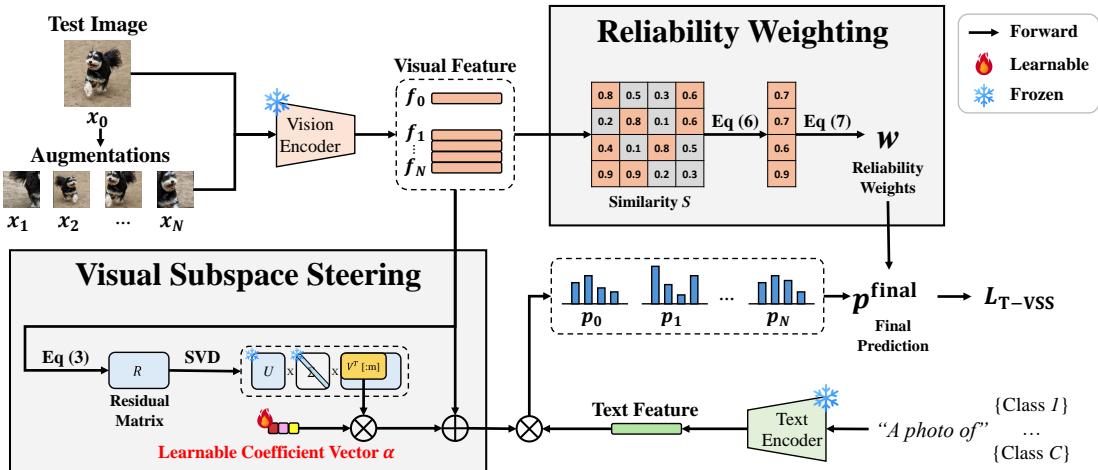
Figureure 1 · : Comparison of test-time adaptation strategies for adversarially robuFigure 1: Comparison of test-time adaptation strategies for adversarially robust vision-language models. (a) R-TPT [40] adapts learnable text prompts through backpropagation in the text branch. (b) TTP [23] optimizes learnable input padding in the pixel space via backpropagation through the vision encoder. (c) In contrast, T-VSS adapts the visual feature space by learning a small set of steering coefficients in a low-rank visual subspace. Compared with prior methods, T-VSS provides a more direct and lightweight correction mechanism.这张图/表用于判断 T-VSS 的实验收益来自哪里。重点看替换、消融或跨模型设置下趋势是否一致,而不是只看单个最高分。Figureure 2 · : Overview of T-VSSFigure 2: Overview of T-VSS. From multi-view CLIP visual features, T-VSS applies Singular Value Decomposition (SVD) to anchor-based residuals to extract a compact visual subspace that captures local cross-view geometry, then learns a shared low-rank correction within that subspace via reliability-weighted entropy minimization. Predictions from the adapted views are finally aggregated using reliability-aware ensembling.这张图概括 T-VSS 的整体方法流程。阅读时先看模块之间传递的训练信号,再看作者如何把目标拆成可优化的子问题。
核心问题
它和通用视觉自监督的关系在于:直接在视觉 feature space 做 test-time correction,提醒 VLM 鲁棒性不应只调 prompt。
方法拆解
直接在视觉 feature space 做 test-time correction,提醒 VLM 鲁棒性不应只调 prompt