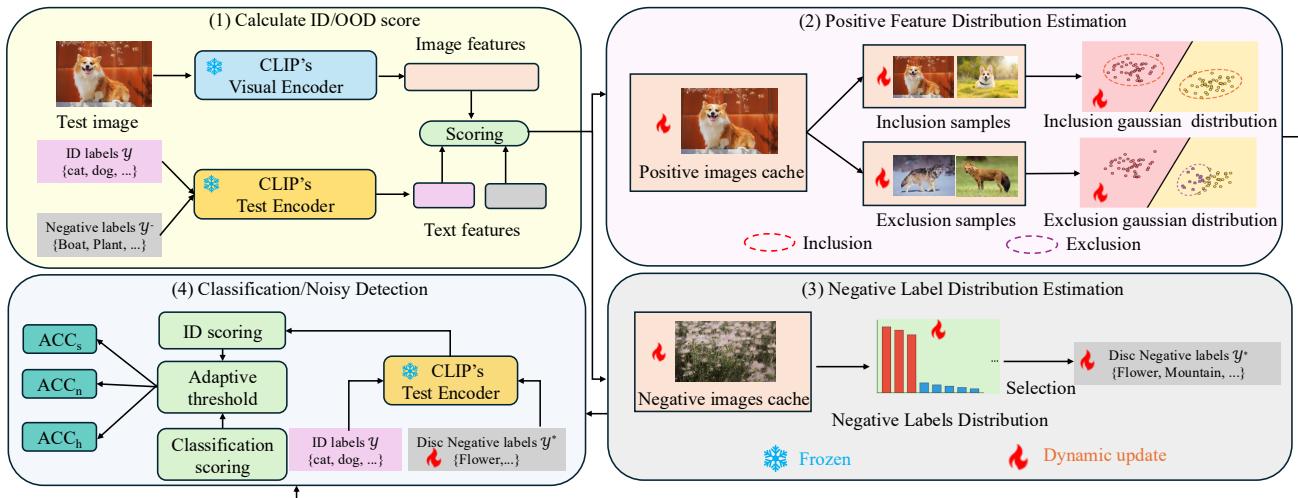
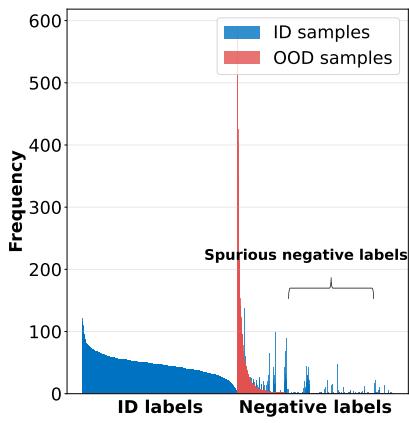
Figureure 2 · Overview of our DDE frameworkFigure 2. Overview of our DDE framework. (1) Calculate the ID/OOD score for test images, dynamically caches positive and negative samples. (2) Model positive feature Gaussian distributions via inclusion and exclusion GDA estimating. (3) Filter the discriminative negative labels via negative labels distribution estimation. (4) Employ an adaptive threshold for simultaneous ID classification and noise detection.这张图概括 Dual Distribution Estimation for Zero-shot 的整体方法流程。阅读时先看模块之间传递的训练信号,再看作者如何把目标拆成可优化的子问题。(c) Label distribution Figure 1(c) Label distribution Figure 1. (a) CLIP vs. DDE Classifiers: AdaND [1] uses the CLIP classifier frequently misclassifying samples that deviate significantly from textual prototypes. Other TTA methods [2] (e.g., DMN) cache high-confidence samples, which still struggle to accurately represent complete visual class distribution. In contrast, our DDE achieves a more precise visual representation by efectively modeling the test distribution. (b) Data scarce setting: Unlike AdaND, which relies on extensive ID and noisy images for training, DDE dynamically models discriminative negative labels. This allows DDE to maintain higher robustness in data-scarce environments. (c) Label distribution: Some negative labels exhibit spurious correlations with clean ID data, whereas OOD outliers strongly align with only a narrow subset of negative labels.这张图来自论文 PDF 的结构化抽取。当前用于辅助理解 Dual Distribution Estimation for Zero-shot 的方法或实验,请结合正文精读段落一起看。