先说结论。它和通用视觉自监督的关系在于:把概念对齐从全局 cosine 改成 OT semantic flow,更适合分析细粒度视觉语义几何。 中高相关;详见方法、贡献和实验边界。
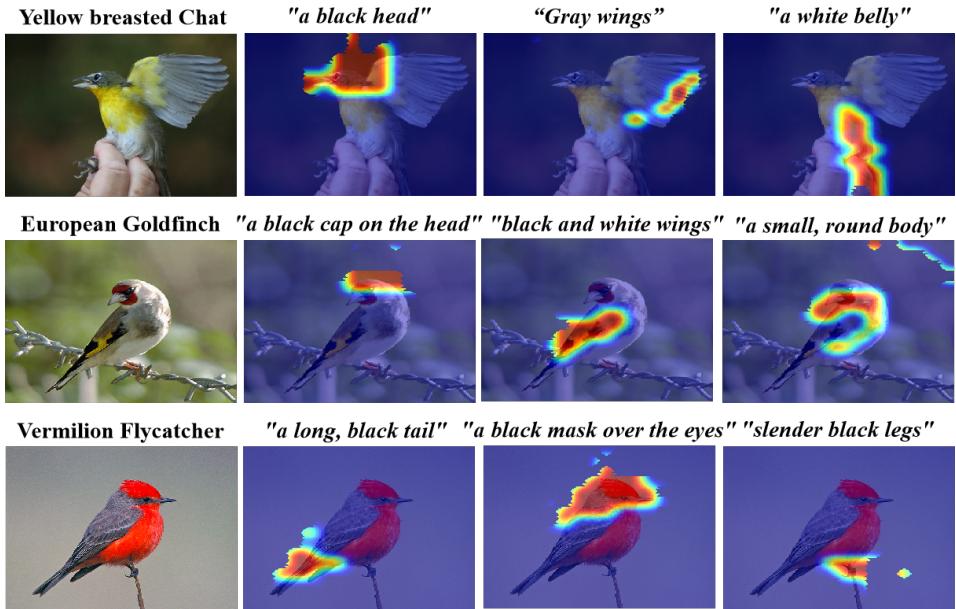
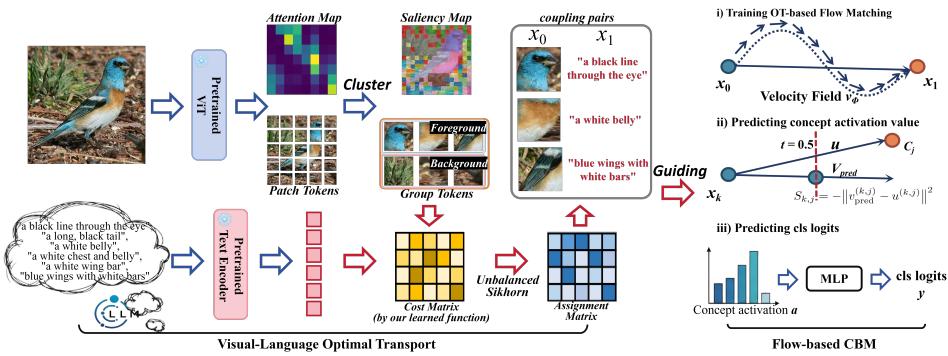
Figureure 1 · : Cross-modal concept visualization with OTF-CBMFig. 1: Cross-modal concept visualization with OTF-CBM. The model localizes fine-grained parts (head, wings, legs) and aligns them with textual concepts. Compared with prior CBMs, it yields more coherent, spatially grounded components and smooth semantic flow from visual features to concept embeddings.这张可视化用来解释 Bridging Vision and Language Concepts 学到的中间表征或对齐关系。重点看它是否支持正文里的机制判断。Figureure 4 · : Forward pipelineFig. 4: Forward pipeline. Patch tokens are clustered into foreground and background. The learned cost $\mathbf { c } _ { \theta ^ { \ast } }$ forms a cost matrix to fixed concept embeddings with background penalties. Unbalanced OT yields a plan π. Samples from π to train a conditional velocity field. At inference, concept activations come from midpoint velocity alignment, then a concept classifier produces labels.这张图概括 Bridging Vision and Language Concepts 的整体方法流程。阅读时先看模块之间传递的训练信号,再看作者如何把目标拆成可优化的子问题。
核心问题
它和通用视觉自监督的关系在于:把概念对齐从全局 cosine 改成 OT semantic flow,更适合分析细粒度视觉语义几何。
方法拆解
把概念对齐从全局 cosine 改成 OT semantic flow,更适合分析细粒度视觉语义几何