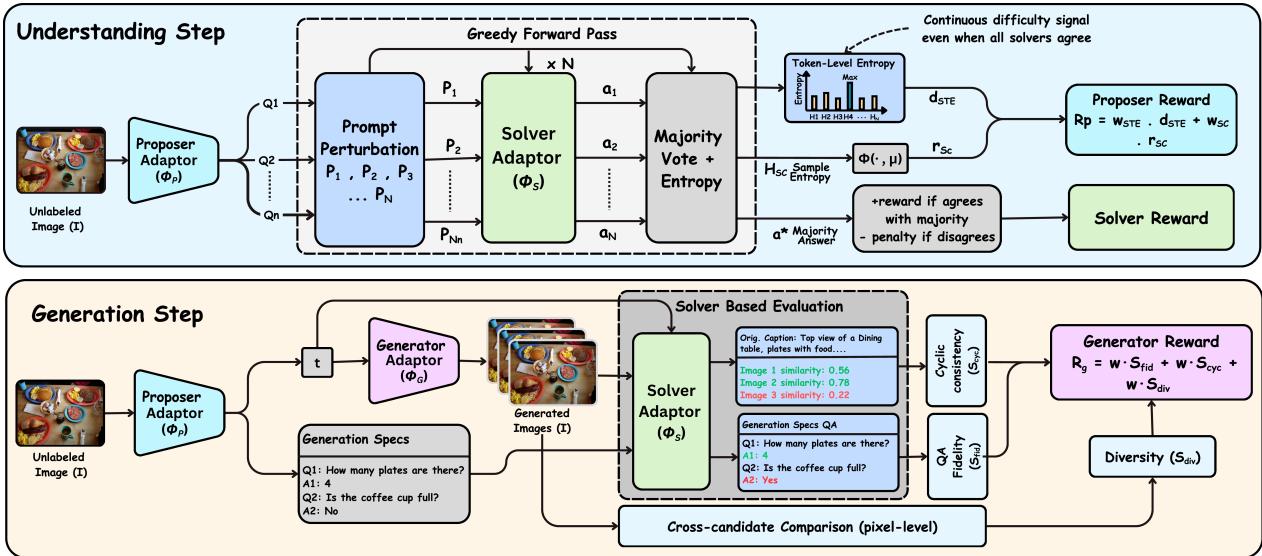
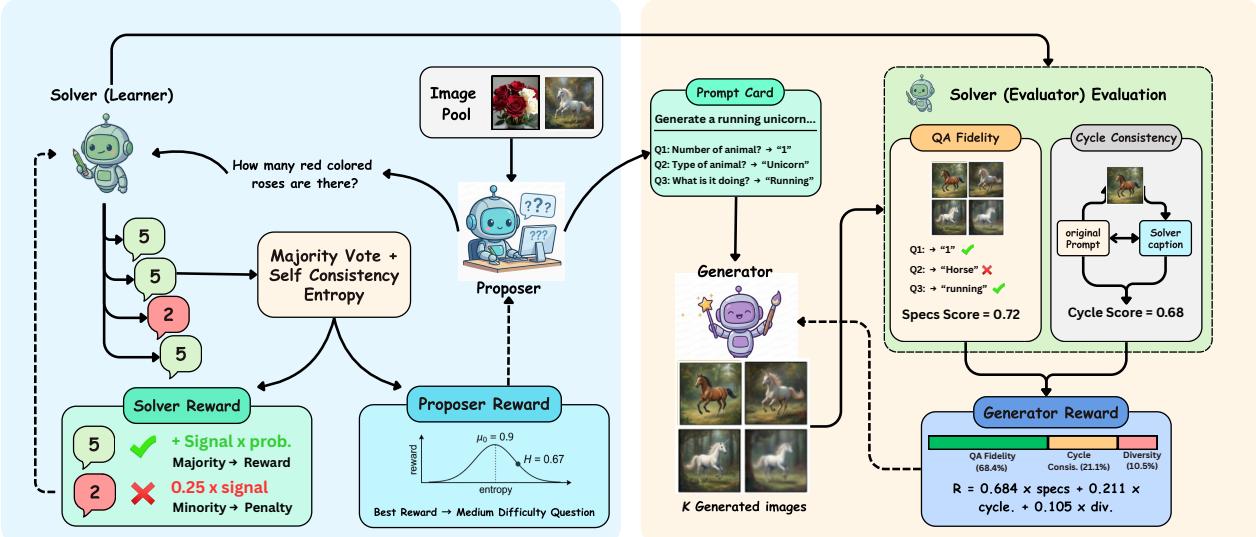
Figureure 2 · : Overview of our Proposer–Solver–Generator self-evolving frameworkFigure 2: Overview of our Proposer–Solver–Generator self-evolving framework. Given only a frozen backbone and unlabeled images, we attach three lightweight LoRA adapters for the Proposer, Solver, and Generator roles. In understanding steps (left), the Proposer generates visual questions, and the Solver answers under multiple prompt perturbations; self-consistency agreement and Solver Token Entropy (STE) jointly produce the training signal, encouraging informative questions at the Solver’s competence frontier. In generation steps (right), the Generator synthesizes images from prompt cards and the same Solver evaluates them via QA fidelity and cycle-consistent captioning. Thus, visual-understanding updates improve the internal evaluator that supplies generation rewards, while all roles remain trained without labels or task-trained reward/judge models.这张图概括 Ask, Solve, Generate 的整体方法流程。阅读时先看模块之间传递的训练信号,再看作者如何把目标拆成可优化的子问题。Figureure 1 · : Overview of our self-evolving frameworkFigure 1: Overview of our self-evolving framework. Three LoRA adapters–Proposer, Solver, and Generator–are trained on a frozen backbone using only unlabeled images. The understanding loop uses prompt-perturbed selfconsistency and Solver Token Entropy (STE), while the generation loop uses the Solver as an internal evaluator through QA fidelity and cycle-consistent captioning.这张图概括 Ask, Solve, Generate 的整体方法流程。阅读时先看模块之间传递的训练信号,再看作者如何把目标拆成可优化的子问题。