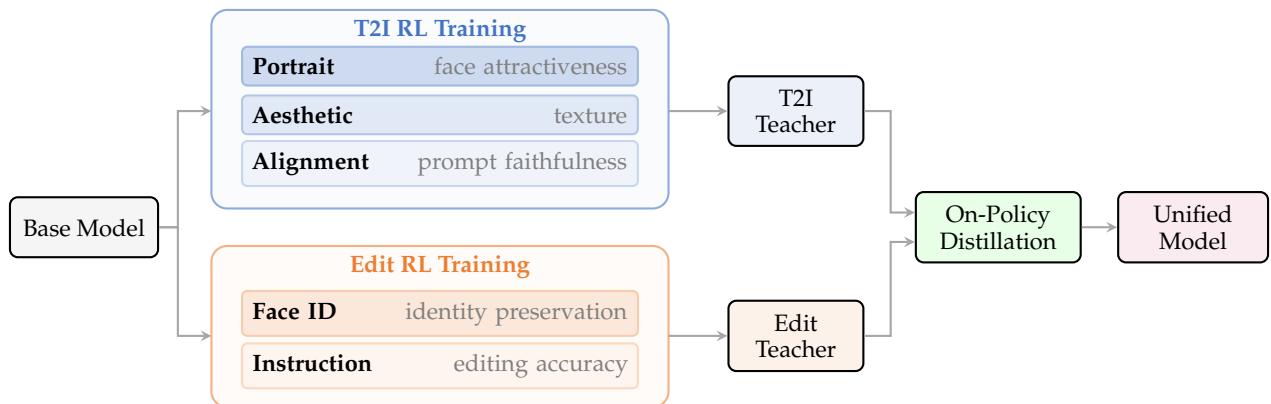
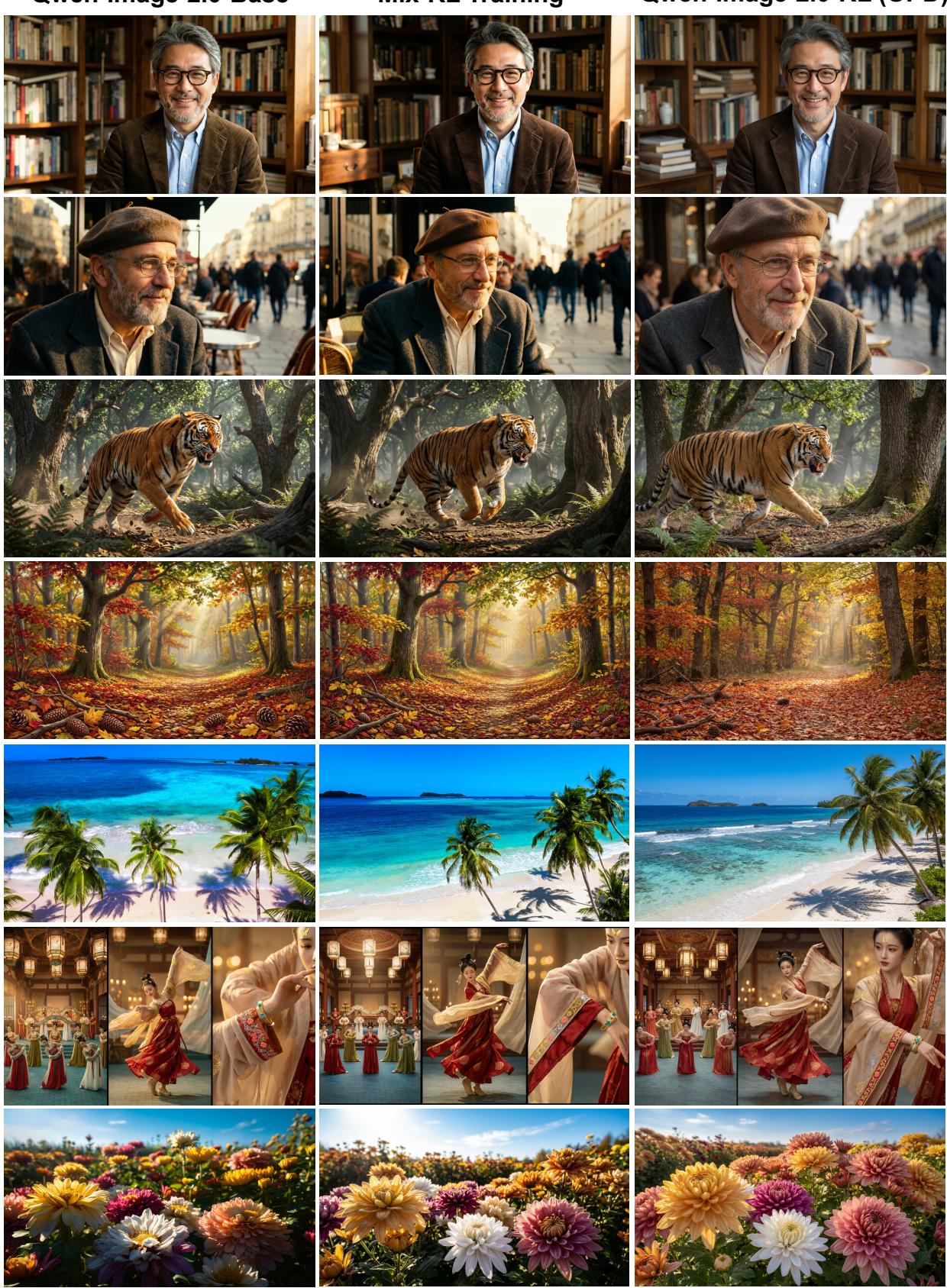
Figureure 1 · : Overview of the Qwen-Image-2.0-RL training pipelineFigure 1: Overview of the Qwen-Image-2.0-RL training pipeline. Starting from a shared base model, we train two task-specialized RL policies with dedicated reward compositions: T2I generation uses a layered reward design progressing from prompt faithfulness to texture quality to portrait-specific optimization, while editing focuses on instruction accuracy and identity preservation. The resulting teachers are merged into a unified model via on-policy distillation.这张图概括 Qwen-Image-2.0-RL Technical Report 的整体方法流程。阅读时先看模块之间传递的训练信号,再看作者如何把目标拆成可优化的子问题。Qwen-Image-2.0-Base Mix-RL Training Qwen-Image-2.0-RL (OPD) Figure 5: Qualitative comparisQwen-Image-2.0-Base Mix-RL Training Qwen-Image-2.0-RL (OPD) Figure 5: Qualitative comparison across T2I generation scenarios among three model variants: pre-trained Qwen-Image-2.0-Base, Mix-RL (jointly trained on T2I and editing tasks with mixed RL rewards), and Qwen-Image-2.0-RL (task-specialized RL teachers distilled via on-policy distillation). The progression Qwen-Image-2.0-Base → Mix-RL → Qwen-Image-2.0-RL demonstrates that RL training improves visual quality over the pre-trained baseline, and that OPD further surpasses mixed RL by avoiding cross-task optimization conflicts. 11这张图/表用于判断 Qwen-Image-2.0-RL Technical Report 的实验收益来自哪里。重点看替换、消融或跨模型设置下趋势是否一致,而不是只看单个最高分。