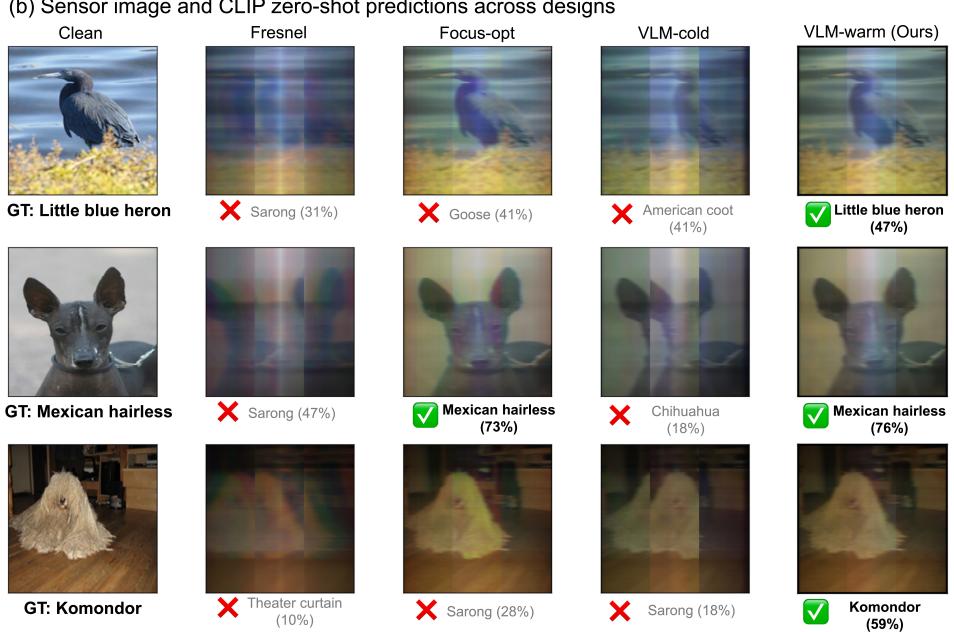
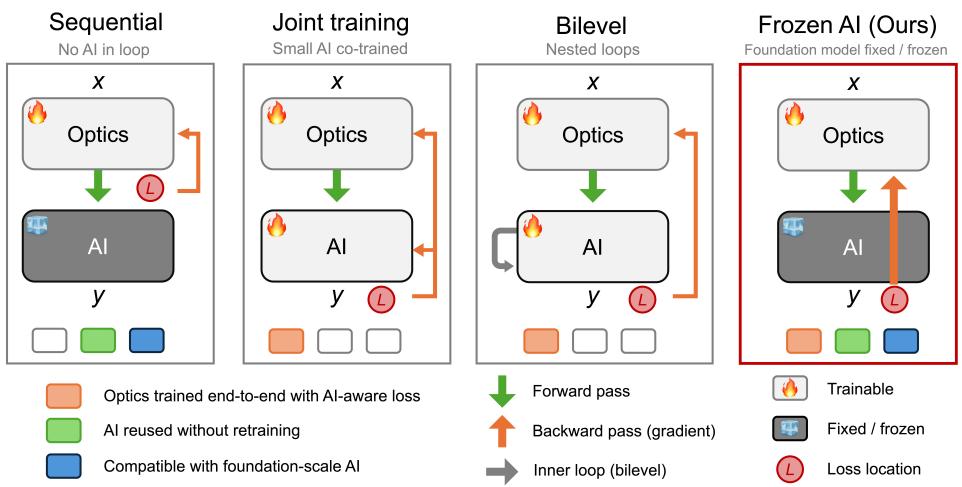
Figureure 5 · : (a) Representative optical designs and fields for the Table 1 comparFig. 5: (a) Representative optical designs and fields for the Table 1 comparison. (b) Qualitative sensor images and CLIP ViT-L/14 zero-shot predictions on ImageNet-100 validation examples. Columns compare the clean image with sensor images from the Fresnel zone plate, Focus-opt, VLM-cold, and VLM-warm designs. Labels show the top-1 prediction and confidence; GT denotes the ground-truth class. The examples are illustrative, and quantitative claims use the full validation set.这张图/表用于判断 VLM-Aware Meta-Optic Front-End Design for 的实验收益来自哪里。重点看替换、消融或跨模型设置下趋势是否一致,而不是只看单个最高分。Figureure 2 · : Representative optics-adaptation formulations for optics–AI codesignFig. 2: Representative optics-adaptation formulations for optics–AI codesign. Green/orange arrows denote forward/backward passes, and light/dark blocks indicate trainable/frozen components. Unlike sequential, joint, and bilevel formulations, CODA freezes the visual foundation model and back-propagates its classification loss only to the meta-optic density.这张图来自论文 PDF 的结构化抽取。当前用于辅助理解 VLM-Aware Meta-Optic Front-End Design for 的方法或实验,请结合正文精读段落一起看。