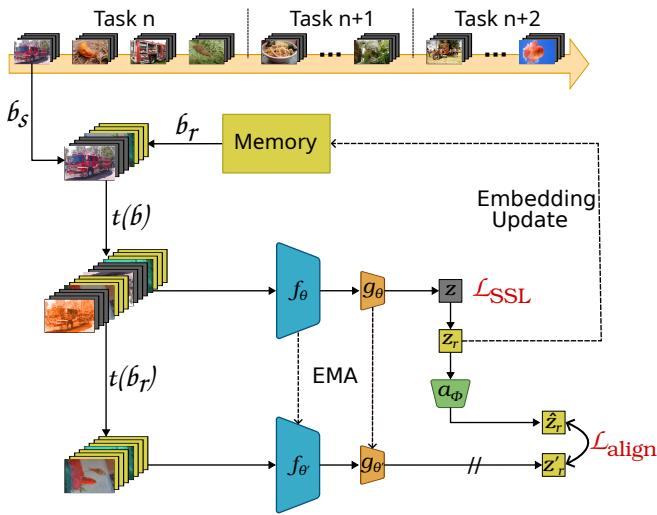
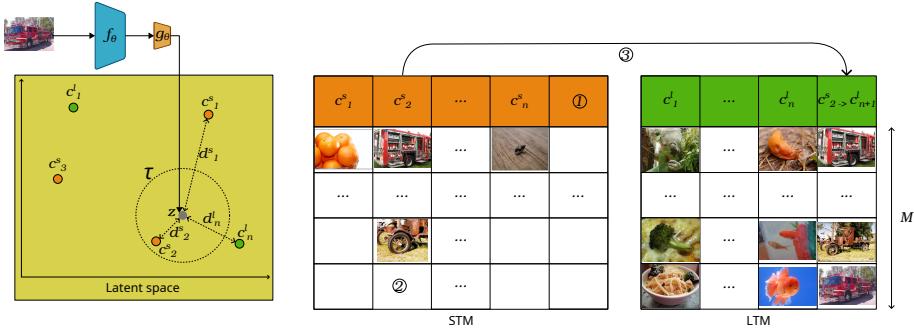
Figureure 1 · : Overview of CLIMB’s architectureFigure 1: Overview of CLIMB’s architecture. At each step, a stream mini-batch $b _ { s }$ is combined with a replay batch $b _ { r }$ sampled from the hierarchical centroid memory to form the final batch $b = b _ { s } \cup b _ { r }$ . The online network $( f _ { \boldsymbol { \theta } } , g _ { \boldsymbol { \theta } } )$ processes b under two augmented views, producing embeddings $z = g _ { \boldsymbol { \theta } } ( f _ { \boldsymbol { \theta } } ( t ( \boldsymbol { b } ) ) )$ ) for the contrastive loss ${ \mathcal { L } } _ { \mathrm { S S L } }$ . The alignment loss $\mathcal { L } _ { \mathrm { a l i g n } }$ is computed as the negative cosine similarity between present representations of the replay subset, passed through projection head $a _ { \phi } .$ , and past representations $z _ { r } ^ { \prime } \overset { \cdot } { = } g _ { \theta ^ { \prime } } ( f _ { \theta ^ { \prime } } ( \bar { t } ( b _ { r } ) ) )$ produced by the frozen EMA target network $( f _ { \theta ^ { \prime } } , g _ { \theta ^ { \prime } } )$ . Embeddings of replay examples $z _ { r }$ are also used to update the centroid positions in memory.这张图概括 CLIMB 的整体方法流程。阅读时先看模块之间传递的训练信号,再看作者如何把目标拆成可优化的子问题。Figureure 2 · : Overview of CLIMB’s hierarchical memoryFigure 2: Overview of CLIMB’s hierarchical memory. $c _ { i }$ denotes centroid positions in the projected latent space, and $d _ { i }$ denotes the cosine distances between each centroid and the current image embedding. The short-term memory (STM) is shown in orange and the long-term memory (LTM) in green. ⃝1 If min $( d _ { i } ) > \tau ,$ a new centroid is instantiated from the current image. $\textcircled{2}$ Otherwise, the image is assigned to the nearest centroid if it belongs to the STM. ⃝3 When a centroid reaches $M$ examples, it is promoted to the LTM and removed from the STM.这张图概括 CLIMB 的整体方法流程。阅读时先看模块之间传递的训练信号,再看作者如何把目标拆成可优化的子问题。