编号2607.00293优先级P1类别arXiv new/cross; composable multimodal pretraining会议arXiv new/cross; composable multimodal pretraining方法聚焦新模态接入时的 representation overwriting,适合放进 multimodal foundation model 训练路线来源arXiv / OpenReview
先说结论。它和通用视觉自监督的关系在于:聚焦新模态接入时的 representation overwriting,适合放进 multimodal foundation model 训练路线。 中高相关;详见方法、贡献和实验边界。
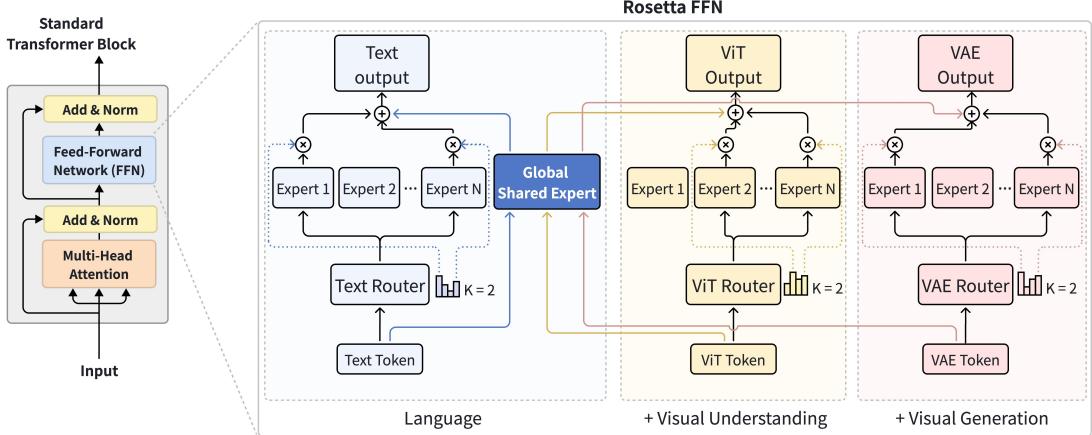
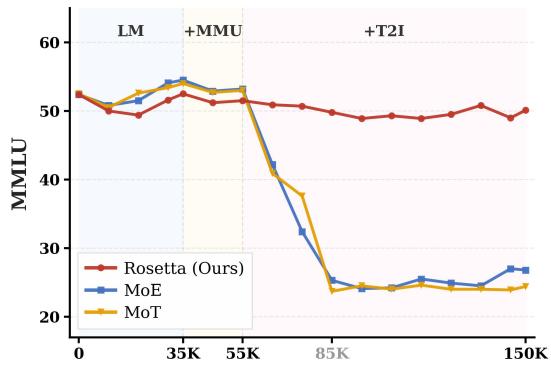
Figureure 2 · : Architectural Overview of RosettaFigure 2: Architectural Overview of Rosetta. Our framework ensures non-destructive modality expansion via three mechanisms: (1) Unified Attention (left): Maintains globally shared QKV projections across all modalities to preserve dense cross-modal interactions. (2) Composable FFN (right): Selectively routes tokens to plug-and-play task-specific experts, bridged by a Global Shared Expert. (3) Conflict-Free Optimization: Momentum-Anchored Orthogonal Projection (MAOP) surgically neutralizes destructive gradients with zero memory overhead, converting modality interference into cross-modal synergy.这张图概括 Rosetta 的整体方法流程。阅读时先看模块之间传递的训练信号,再看作者如何把目标拆成可优化的子问题。Figureure 1 · : Escaping the Forgetting-Synergy DilemmaFigure 1: Escaping the Forgetting-Synergy Dilemma. (Left) Performance dynamics on MMLU benchmark across composable pretraining stages. While standard MoE and structurally isolated MoT suffer from catastrophic routing collapse and degradation upon the integration of continuous generative objectives (+T2I), our Rosetta architecture acts as a robust semantic anchor, maintaining a highly stable foundation. (Right) Qualitative results of Rosetta, demonstrating that the preservation of foundational knowledge seamlessly unlocks superior visual generation capabilities.这张图概括 Rosetta 的整体方法流程。阅读时先看模块之间传递的训练信号,再看作者如何把目标拆成可优化的子问题。
核心问题
它和通用视觉自监督的关系在于:聚焦新模态接入时的 representation overwriting,适合放进 multimodal foundation model 训练路线。
方法拆解
聚焦新模态接入时的 representation overwriting,适合放进 multimodal foundation model 训练路线