先说结论。它和通用视觉自监督的关系在于:虽然是 4D point cloud,但核心是把 DINOv2/V-JEPA dense patch semantics 蒸馏到动态几何编码器。 中高相关;详见方法、贡献和实验边界。
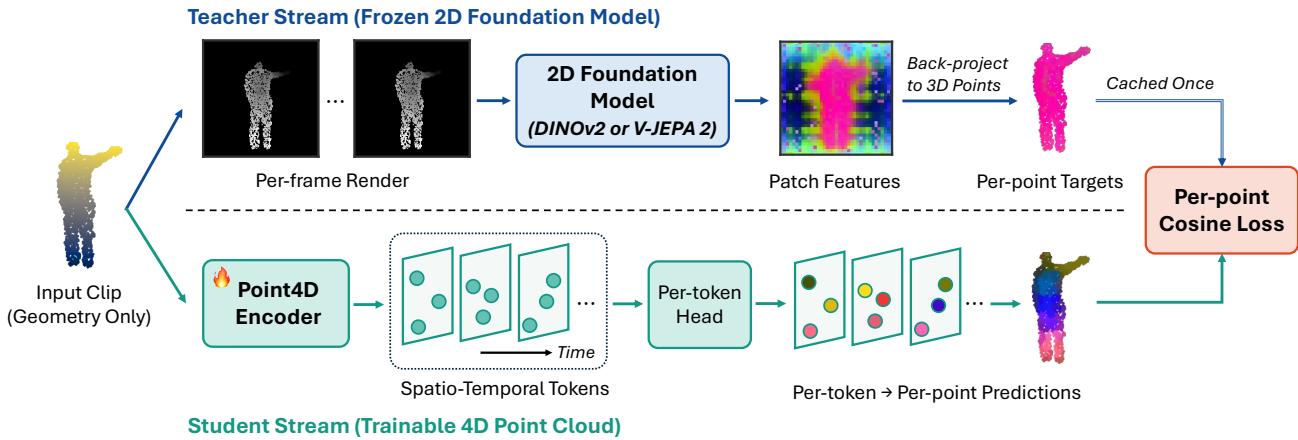
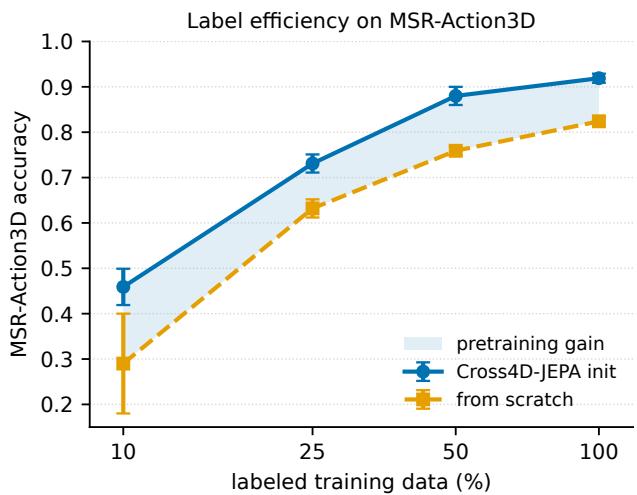
Figureure 1 · Overview of Cross4D-JEPAFigure 1. Overview of Cross4D-JEPA. A frozen 2D foundation model (top) encodes each rendered frame, and its patch features are pulled back onto the 3D points they depict, giving a per-point target cached once. A trainable 4D encoder (bottom) maps the clip to spatio-temporal tokens, and a per-token head predicts each token's target in the teacher's latent space under a cosine loss, with no masking, negatives, or decoder. The distillation is dense, per point rather than per clip.这张图概括 Cross4D-JEPA 的整体方法流程。阅读时先看模块之间传递的训练信号,再看作者如何把目标拆成可优化的子问题。Figureure 6 · Label efficiency on MSR-Action3DFigure 6. Label efficiency on MSR-Action3D. Action-recognition accuracy versus the fraction of labeled training clips, for a from-scratch encoder (orange) and the same architecture initialized from Cross4D-JEPA pretraining (blue); error bars are over seeds and the shaded band is the pretraining gain. The dense-distilled initialization helps most when labels are scarce (+17 points at 10%) and remains ahead at full supervision (91.9% vs. 82.4%).这张图概括 Cross4D-JEPA 的整体方法流程。阅读时先看模块之间传递的训练信号,再看作者如何把目标拆成可优化的子问题。
核心问题
它和通用视觉自监督的关系在于:虽然是 4D point cloud,但核心是把 DINOv2/V-JEPA dense patch semantics 蒸馏到动态几何编码器。
方法拆解
虽然是 4D point cloud,但核心是把 DINOv2/V-JEPA dense patch semantics 蒸馏到动态几何编码器