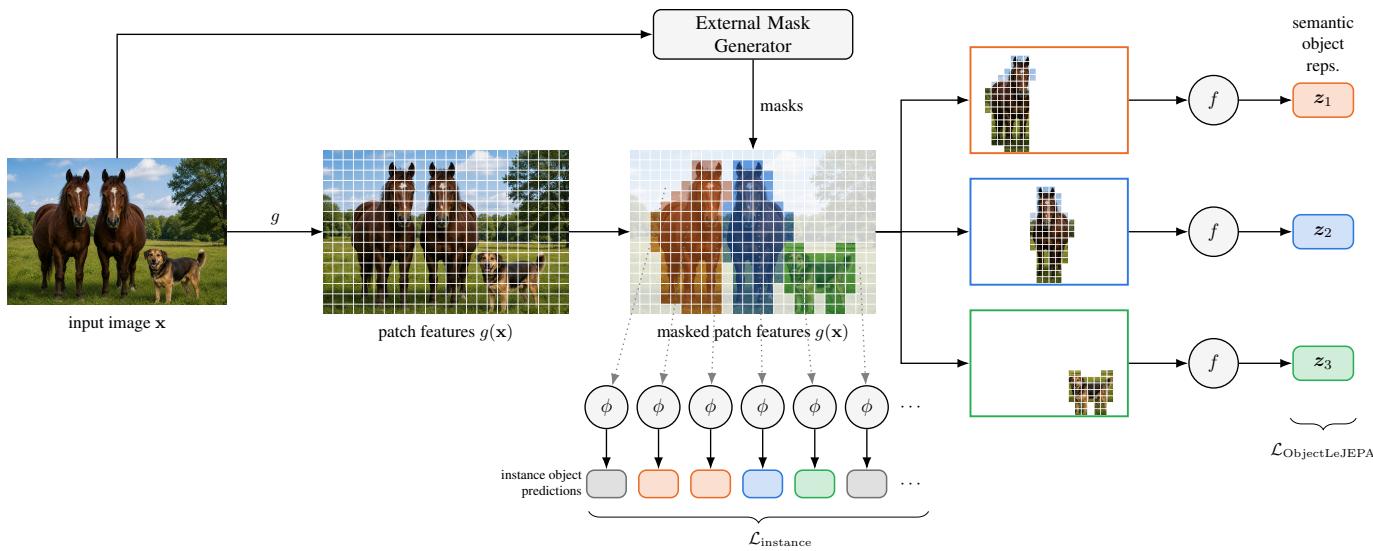
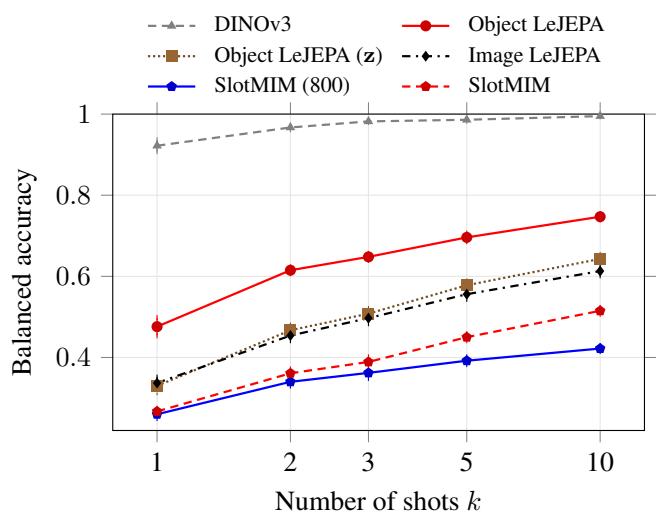
Figureure 1 · Overview over our training frameworkFigure 1. Overview over our training framework. An exemplary input image x, generated by [25], is embedded by the ViT backbone g into per-patch features. An external mask generator generates object masks for the same image - here two horses and a dog (orange, blue, green). For each object, the aggregator $f$ pools its patch features into a single object representation $\mathbf { z } _ { k }$ . The proposed object-centric LeJEPA loss $\mathcal { L } _ { \mathrm { O b j e c t L e J E P A } }$ (bottom right) shapes their semantic geometry via cross-view alignment, here ideally resulting in the two horses $( \mathbf { z } _ { 1 } , \mathbf { z } _ { 2 } )$ having similar representations while keeping the dog $\left( \mathbf { z } _ { 3 } \right)$ different. Every patch is mapped by the instance projection $\phi$ to an instance object prediction (colored by object, background patches in gray). The instance-level contrastive loss $\mathcal { L } _ { \mathrm { i n s t a n c e } }$ clusters predictions of the same object together while keeping them separable from other objects and the background.这张图概括 Object-centric LeJEPA 的整体方法流程。阅读时先看模块之间传递的训练信号,再看作者如何把目标拆成可优化的子问题。Figureure 3 · Few-shot instance re-identification on NAVIFigure 3. Few-shot instance re-identification on NAVI. Balanced accuracy of a nearest-neighbour classifier versus the number of shots per instance $( k \in \{ 1 , 2 , 3 , 5 , 1 0 \}$ , log-scaled x-axis), using object representations obtained by average pooling patch features over the ground-truth masks. For Object LeJEPA we additionally report its semantic object representations z.这张图/表用于判断 Object-centric LeJEPA 的实验收益来自哪里。重点看替换、消融或跨模型设置下趋势是否一致,而不是只看单个最高分。