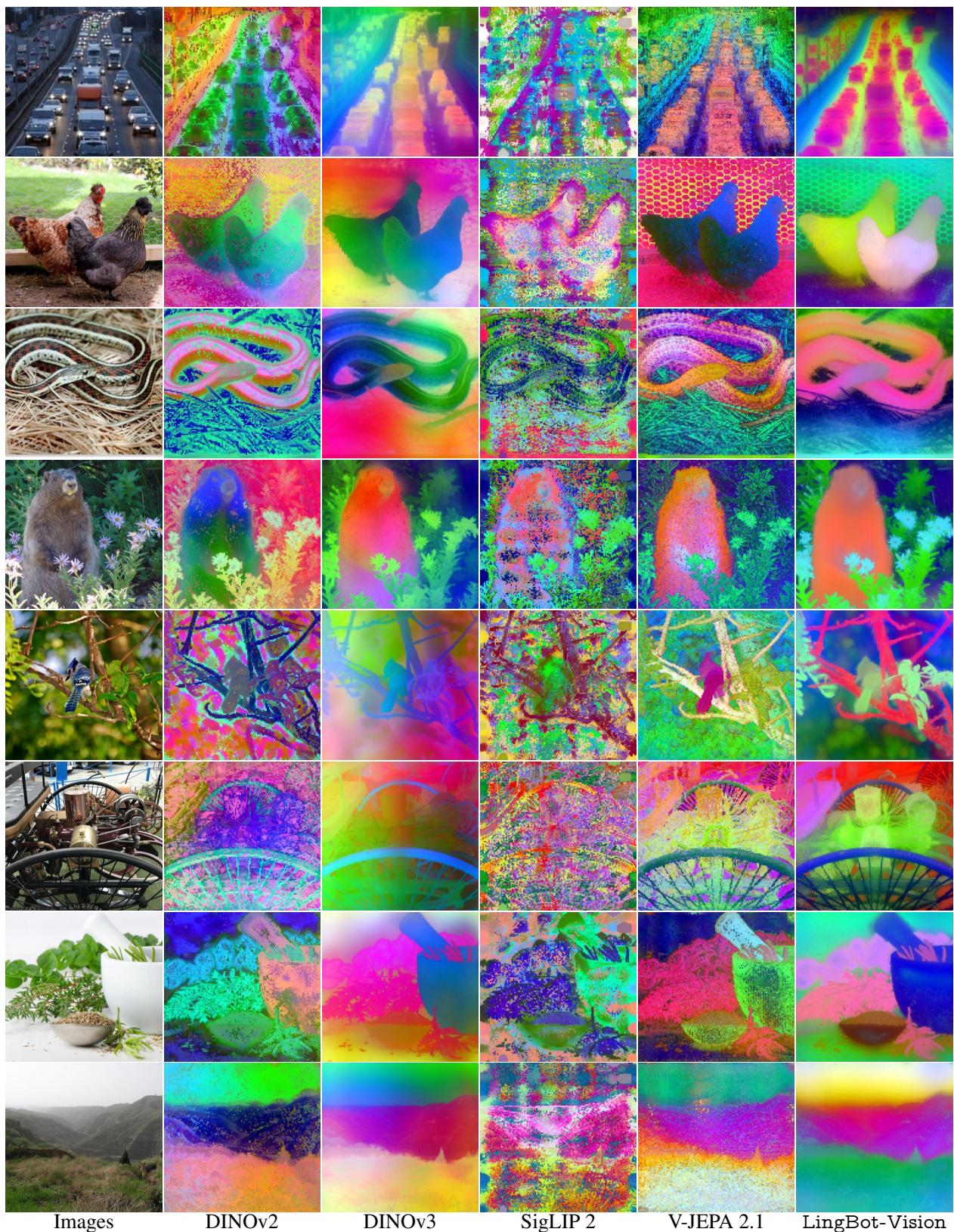
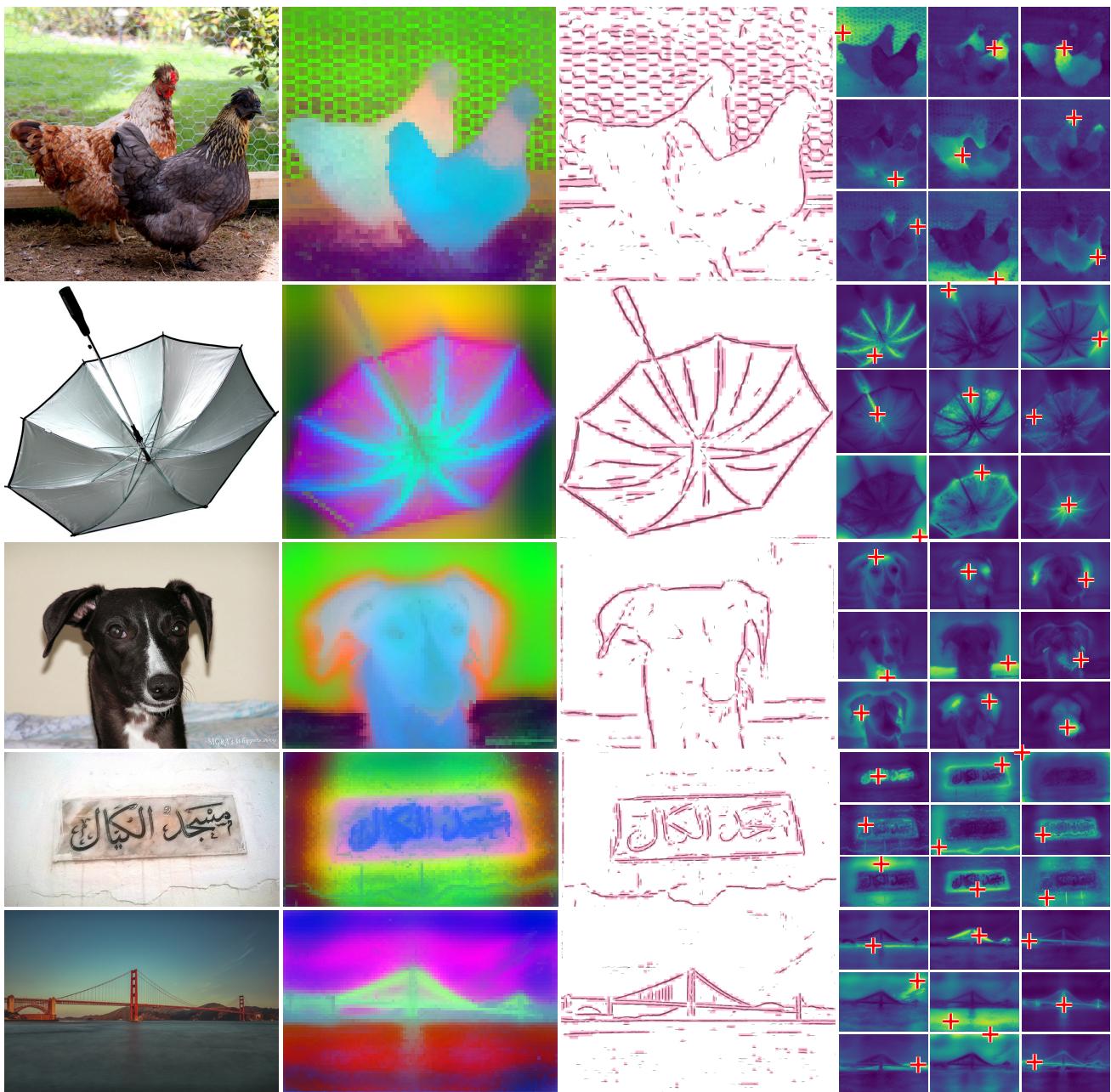
Figureure 6 · PCA of frozen patch featuresFigure 6. PCA of frozen patch features. The top three PCA components of the patch features are mapped to RGB, computed per image for each model (one model per column). LingBot-Vision (rightmost) resolves objects as coherent regions with crisp boundaries: individual cars and lane structure in the traffic scene, hen silhouettes against the wire fence, the winding contour of the snake, and fine structures such as flower stalks and branches. In comparison, DINOv2 exhibits per-token speckle, SigLIP 2 degrades into blocky noise, and V-JEPA 2.1 lets background texture bleed into the foreground regions.这张图/表用于判断 Vision Pretraining for Dense Spatial 的实验收益来自哪里。重点看替换、消融或跨模型设置下趋势是否一致,而不是只看单个最高分。Figureure 1 · LingBot-Vision learns dense representations via boundary-centric maskeFigure 1. LingBot-Vision learns dense representations via boundary-centric masked modeling. Each row, from left to right: the input image; the PCA projection of the frozen teacher’s patch tokens; boundary tokens (pink) obtained by a-contrario validation of dense line proposals decoded from the model’s own boundary-field prediction, overlaid on the accumulated response of the validated proposals; and cosine-similarity maps between nine boundary-token queries (red crosses, selected by farthest-point sampling in feature space) and all patch tokens. The learned representations carry both semantic grouping and geometric structures. Input images are at 1024px for the short side.这张可视化用来解释 Vision Pretraining for Dense Spatial 学到的中间表征或对齐关系。重点看它是否支持正文里的机制判断。