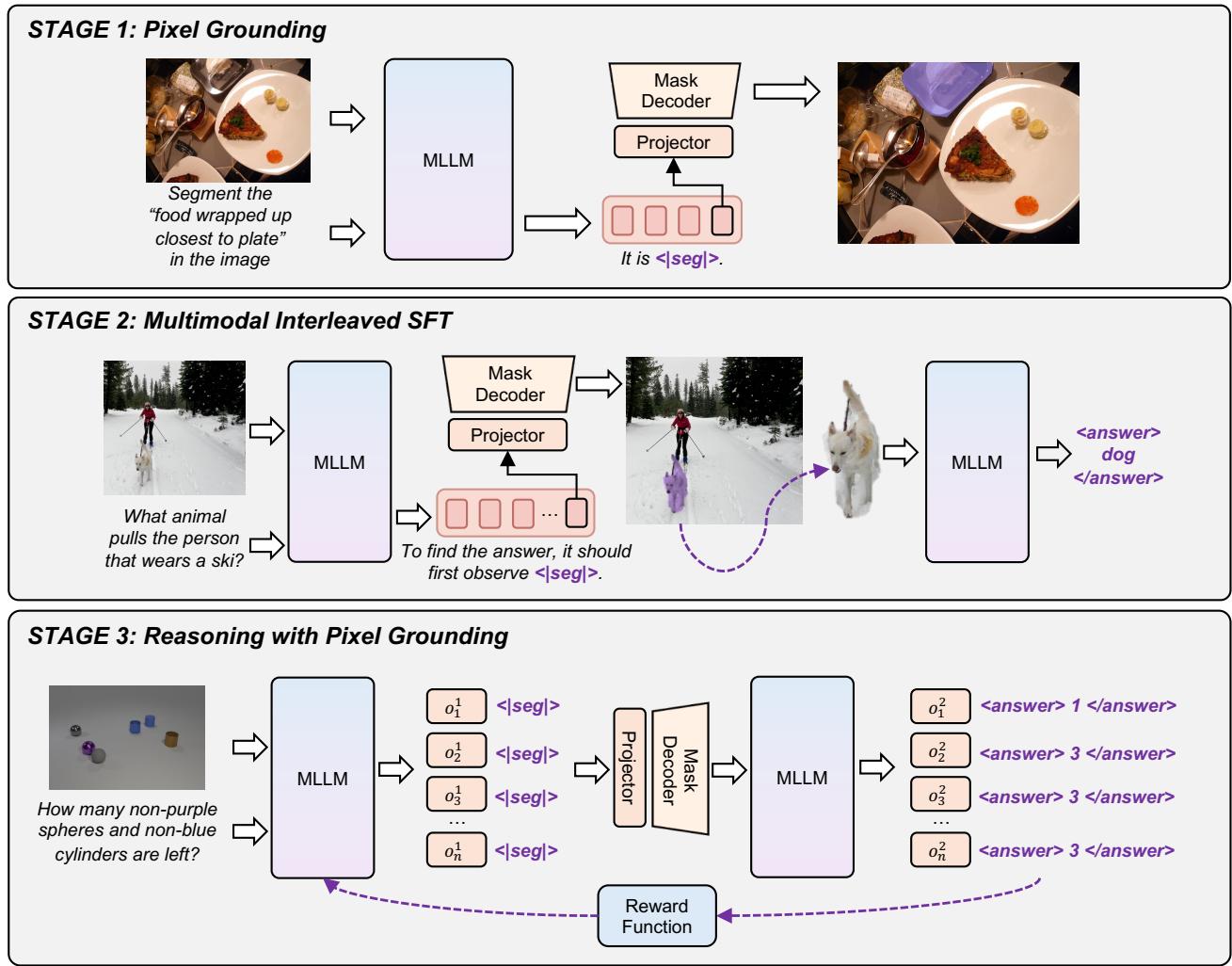
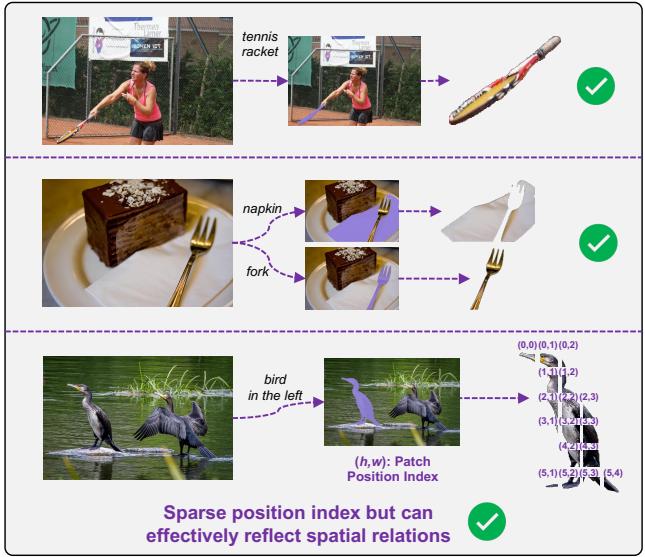
Figureure 2 · Overview of our SegAnswer methodFigure 2. Overview of our SegAnswer method. The training pipeline progresses through three stages: Stage 1: Pixel Grounding aligns textual semantics with pixel-level features, training the MLLM to generate segmentation masks via a specialized <|seg|> token and a mask decoder. Stage 2: Multimodal Interleaved SFT enables the model to employ segmentation as an intermediate conversation step, using the generated mask to focus the visual context before answering. Stage 3: Reasoning with Pixel Grounding utilizes reinforcement learning to enhance MLLM visual reasoning by precise and finer segmented visual inputs.这张图概括 Segmentation before Answering 的整体方法流程。阅读时先看模块之间传递的训练信号,再看作者如何把目标拆成可优化的子问题。(b) Our segmentation-based pixel grounding(b) Our segmentation-based pixel grounding. Figure 1. Comparison between the BBox-based zoom-in operation and our segmentation-based pixel grounding. (a) Rectangular bounding boxes inevitably introduce redundant background regions (e.g., the background around the sloping tennis racket) and fail to precisely disentangle the region of interest from overlapping objects (e.g., the fork and napkin), leading to visual noise and semantic ambiguity. (b) Pixel-level segmentation can precisely isolate the region of interest, effectively eliminating background noise and decoupling adjacent entities. In addition, by keeping the position index of the original image, sparse segmented image patches can also effectively reflect spatial relations.这张图/表用于判断 Segmentation before Answering 的实验收益来自哪里。重点看替换、消融或跨模型设置下趋势是否一致,而不是只看单个最高分。