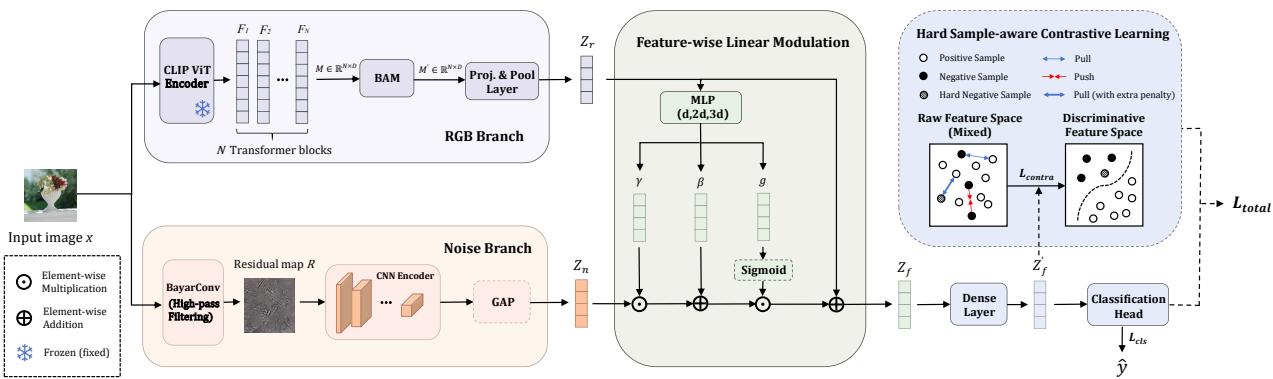
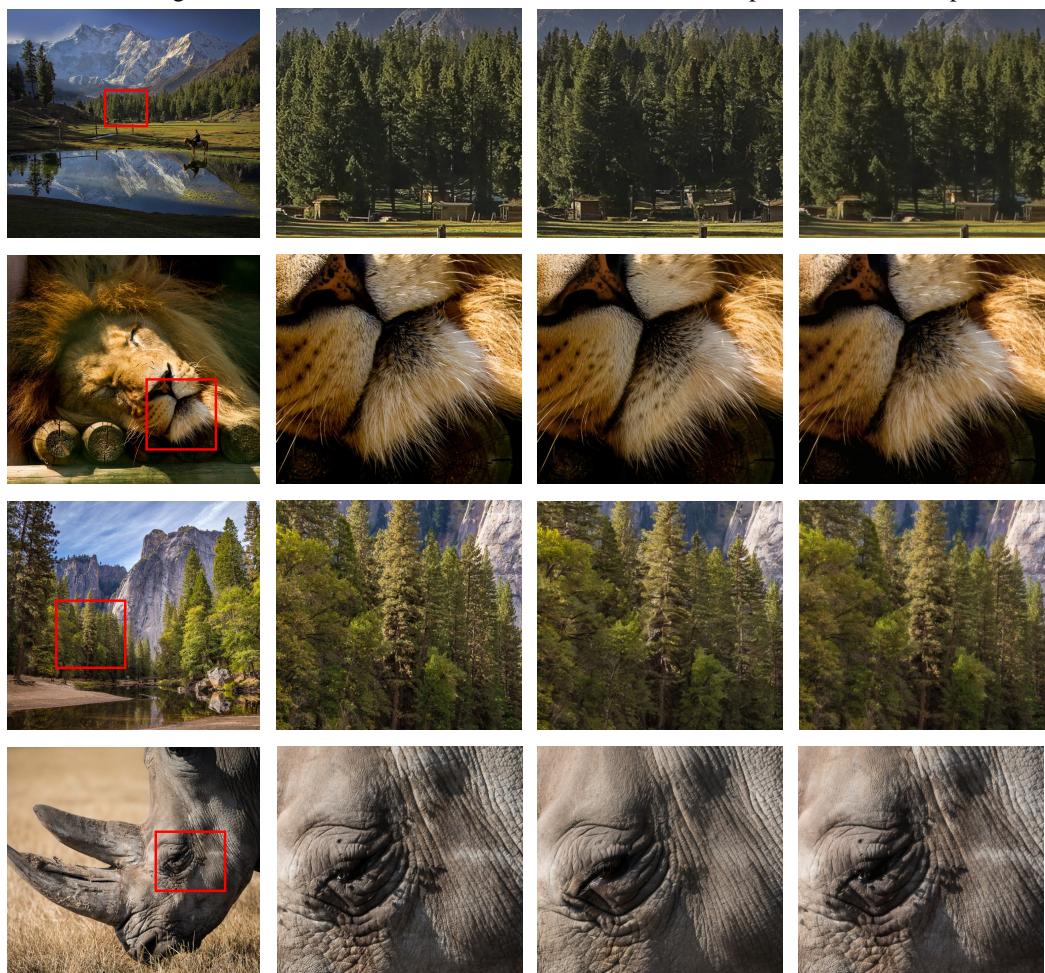
Figureure 1 · : Overview of the proposed RNSIDNet frameworkFigure 1: Overview of the proposed RNSIDNet framework. The input image is processed through two parallel branches: an RGB branch that extracts multi-scale representations using a frozen CLIP-ViT encoder and a Balanced Attention Module (BAM), and a noise branch that captures high-frequency residuals via Bayar convolution followed by Global Average Pooling (GAP). The heterogeneous features are subsequently integrated using a dynamic Feature-wise Linear Modulation (FiLM) module guided by the RGB features. Finally, the network is jointly optimized by a classification loss $\left( \boldsymbol { L } _ { c l s } \right)$ and a contrastive loss $\left( L _ { c o n t r a } \right)$ driven by the Hard Sample-aware Contrastive Learning (HSCL) strategy, explicitly enforcing intra-class compactness and inter-class separation.这张图概括 Generalized Synthetic Image Detection with 的整体方法流程。阅读时先看模块之间传递的训练信号,再看作者如何把目标拆成可优化的子问题。Real image Zoom-in view Stable Diffusion output GAN output Figure 2: Comparison of local dReal image Zoom-in view Stable Diffusion output GAN output Figure 2: Comparison of local details between synthetic and pristine images. From left to right: original image, zoomed-in local patch, SD XL [33] generated image, and Real-ESRGAN [45] generated image.这张图/表用于判断 Generalized Synthetic Image Detection with 的实验收益来自哪里。重点看替换、消融或跨模型设置下趋势是否一致,而不是只看单个最高分。