From RGB Generation to Dense Field Readout:它和通用视觉自监督的关系在于:直接讨论如何从文本到图像生成预训练中读出 dense fields,关系到生成式 VFM 的空间表征可用性
中高相关;详见方法、贡献和实验边界。
From RGB Generation to Dense Field Readout: Pixel-Space Dense Prediction with Text-to-Image Models arXiv new; generative pretraining for dense prediction 原文链接
编号2607.06553优先级P1类别arXiv new; generative pretraining for dense prediction会议arXiv new; generative pretraining for dense prediction方法直接讨论如何从文本到图像生成预训练中读出 dense fields,关系到生成式 VFM 的空间表征可用性来源arXiv / OpenReview
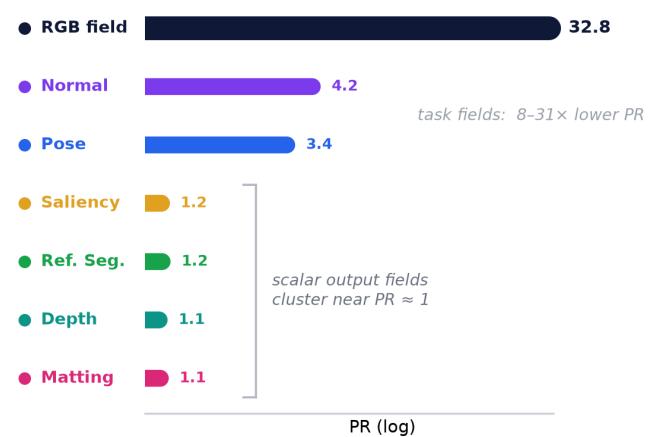
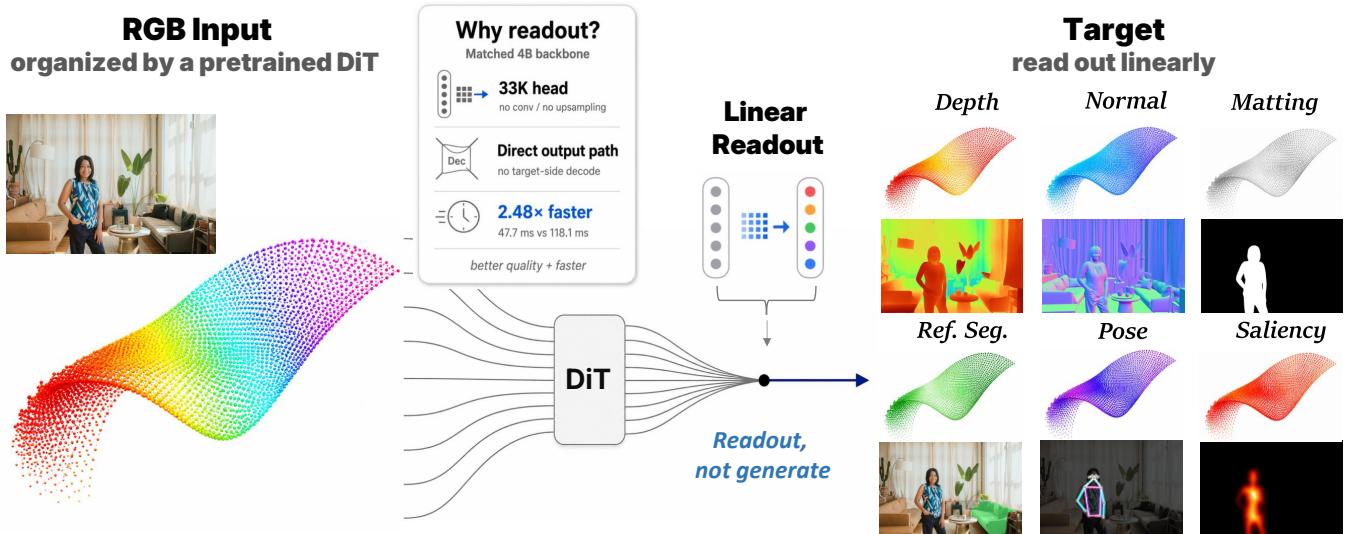
Figureure 2 · Participation ratio (PR) of the token field: the RGB input field (32.8Figure 2. Participation ratio (PR) of the token field: the RGB input field (32.8) is high-dimensional, while task-adapted fields collapse to compact subspaces (1.1–4.2), motivating a token-local linear readout rather than a generative decoder. Per-task PR values are illustrative; the linear head’s sufficiency is shown empirically in Sec. 4.3.这张图来自论文 PDF 的结构化抽取。当前用于辅助理解 From RGB Generation to Dense Field Readout 的方法或实验,请结合正文精读段落一起看。Figureure 1 · ReChannel: readout, not generationFigure 1. ReChannel: readout, not generation. A pretrained DiT organizes RGB inputs into a patch-aligned spatial token field, so dense prediction becomes reading out task-native quantities on the same image plane rather than reconstructing an RGB-style target. Each output patch is a spatial carrier in the DiT lattice; the readout reinterprets its channels from RGB appearance to task-native fields—depth, surface normals, matting, referring segmentation, pose, and saliency. Since these targets are evaluated as pixel-space fields, target-side VAE decoding is unnecessary.这张图来自论文 PDF 的结构化抽取。当前用于辅助理解 From RGB Generation to Dense Field Readout 的方法或实验,请结合正文精读段落一起看。