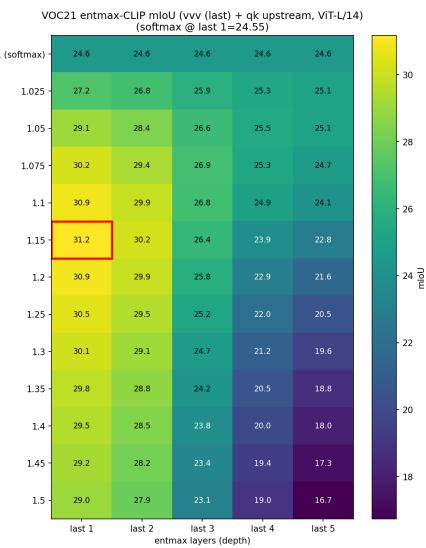
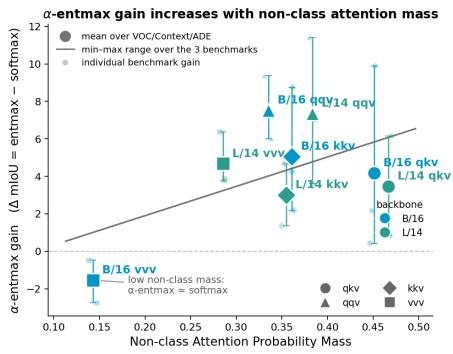
(a) ViT-L/14 qkv Attention (b) ViT-L/14 vvv Attention Fig(a) ViT-L/14 qkv Attention (b) ViT-L/14 vvv Attention Fig. 5: Entmax sparsity vs. depth on Pascal VOC on ViT-L/14 We evaluate the efectiveness of a sparse qkv attention distribution, across diferent depths and entropy regularization. Each cell reports dense-segmentation mIoU when entmax (column: sparsity α) is applied to the last d transformer blocks (row).这张可视化用来解释 Sparse Attention for Dense Open-Vocabulary 学到的中间表征或对齐关系。重点看它是否支持正文里的机制判断。Figureure 1 · : Attention Mass in Softmax vsFig. 1: Attention Mass in Softmax vs. Entmax Distributions. Left: attention distribution for the query patch (green ×) under q-k attention. Entmax denoises the distribution, concentrating mass on the most relevant tokens –the horse’s body vs. the rider– while suppressing irrelevant background. Right: Sparsification helps in proportion to how much the baseline attention spreads of the target class. Where the mass is already very concentrated, entmax does not benefit. The x-axis shows the fraction of a foreground patch’s attention that lands on non-class (irrelevant) patches, measured against the downsampled Pascal VOC ground truth and the y-axis is the α-entmax (α=1.2) minus softmax (α=1.0) segmentation gain. α-entmax benefits when attention is spread across non-class tokens.这张可视化用来解释 Sparse Attention for Dense Open-Vocabulary 学到的中间表征或对齐关系。重点看它是否支持正文里的机制判断。