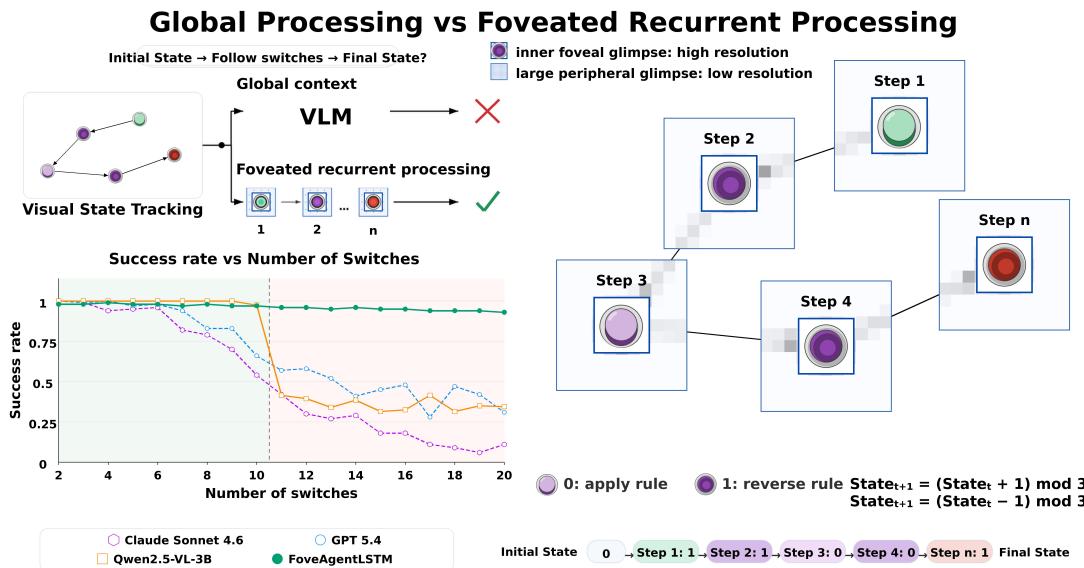
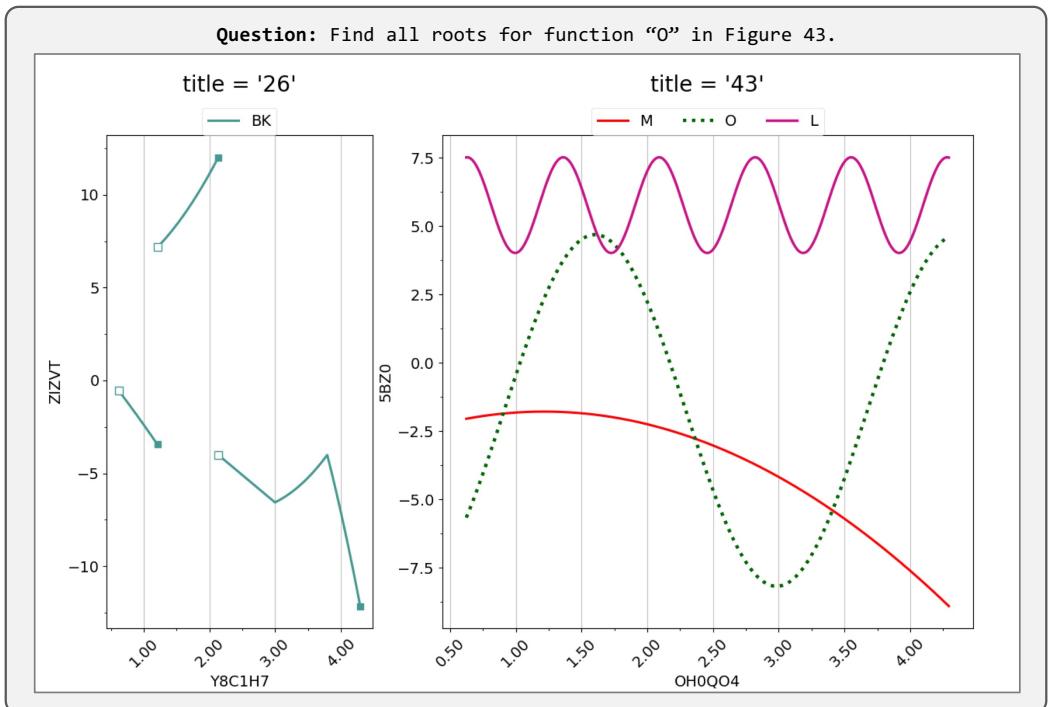
Figureure 1 · : Overview of our work’s central question: How should visual reasoningFigure 1: Overview of our work’s central question: How should visual reasoning models process spatially distributed evidence when test-time task length exceeds the training range? Global models, that process the full image in a single pass, can learn shortcuts that fail out-of-distribution. Foveated recurrent processing, in contrast, decomposes the task into repeated local observations and state updates, which supports generalization to longer visual sequences.这张图概括 On Locality and Length Generalization 的整体方法流程。阅读时先看模块之间传递的训练信号,再看作者如何把目标拆成可优化的子问题。Figureure 13 · : Example from FINDING ROOTSFigure 13: Example from FINDING ROOTS. The model must identify the target subplot and function from the question, then estimate the x-values where the target function crosses zero.这张图来自论文 PDF 的结构化抽取。当前用于辅助理解 On Locality and Length Generalization 的方法或实验,请结合正文精读段落一起看。
核心问题
它和通用视觉自监督的关系在于:用局部/顺序视觉策略研究 visual reasoning 的 length generalization,与全局一次性 ViT 的 shortcut 问题相关。
方法拆解
用局部/顺序视觉策略研究 visual reasoning 的 length generalization,与全局一次性 ViT 的 shortcut 问题相关