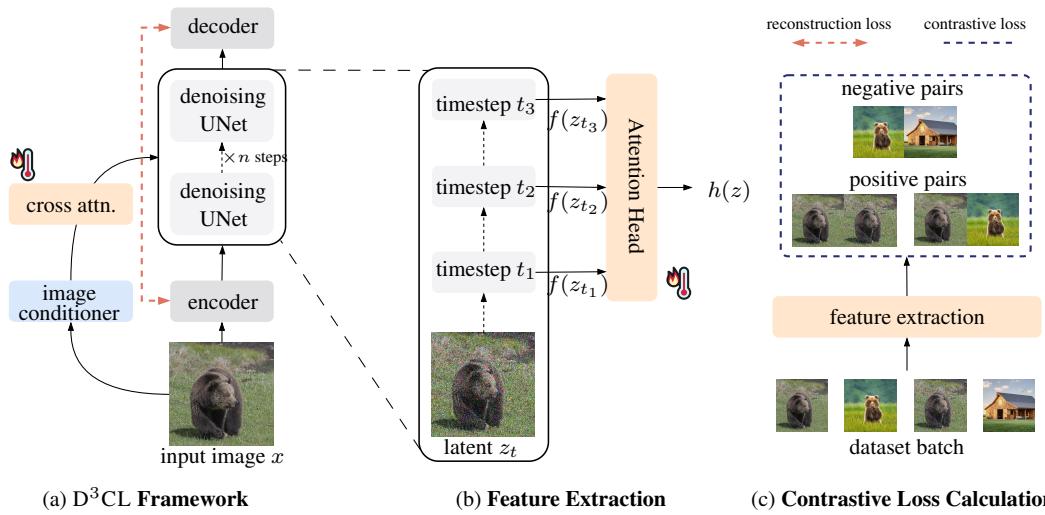
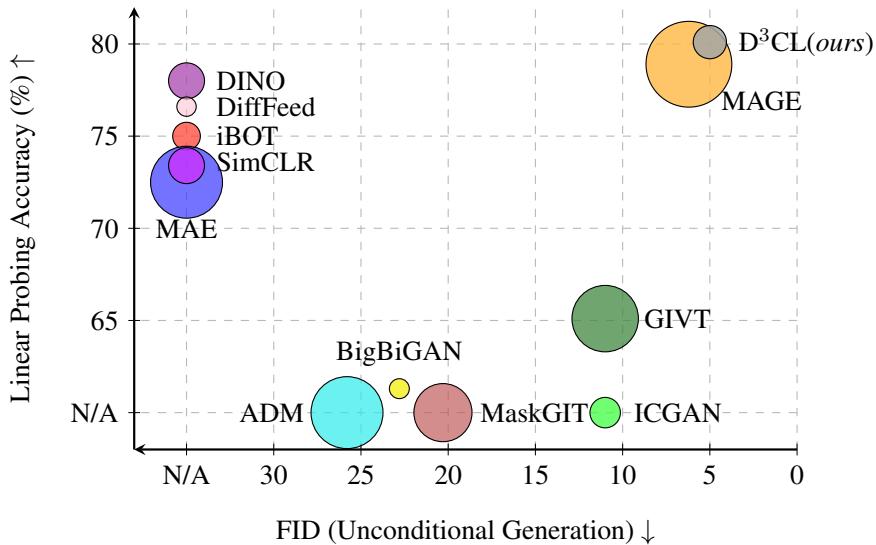
Figureure 2 · : Overview of the $ { \mathbf { D } } ^ { 3 } { \mathbf { C } } { \matFigure 2: Overview of the $ { \mathbf { D } } ^ { 3 } { \mathbf { C } } { \mathbf { L } }$ training pipeline. An input image is encoded by a VAE encoder to produce a latent representation z, which is then perturbed with noise to form a noisy latent of level t. This noisy latent is processed by a denoising UNet with the conditional latent applied on cross-attention layers for n steps. To enhance efficiency, LoRA is applied in the QKV (query, key, value) attention layers. This setup allows $\mathrm { D ^ { 3 } C I }$ to balance generative and discriminative tasks effectively while reducing training resource requirements. The output of UNet is then decoded by a VAE decoder, reconstructing the image from the latent representation.这张图概括 Probing Diffusion Denoising Dynamics for 的整体方法流程。阅读时先看模块之间传递的训练信号,再看作者如何把目标拆成可优化的子问题。Figureure 1 · : $ { \mathbf { D } } ^ { 3 } { \mathbf { C } } { \mathbf { L } }$ balFigure 1: $ { \mathbf { D } } ^ { 3 } { \mathbf { C } } { \mathbf { L } }$ balances accuracy and efficiency. We report linear probing and unconditional image generation performance of different methods on ImageNet-1K. The area of a circle corresponds to the number of trainable parameters. Our method outperforms baseline models in both discriminative (classification) and generative (unconditional image generation) tasks, even surpassing those trained for only one of these tasks. In the meantime, our method maintains a small number of trainable parameters to reduce training resource overhead.这张图/表用于判断 Probing Diffusion Denoising Dynamics for 的实验收益来自哪里。重点看替换、消融或跨模型设置下趋势是否一致,而不是只看单个最高分。