先说结论。它和通用视觉自监督的关系在于:把 object-centric learning 直接放到冻结 VFM 语义特征空间和 DiT 解码里,贴近 DINO/RAE/无监督对象发现主线。 高相关;详见方法、贡献和实验边界。
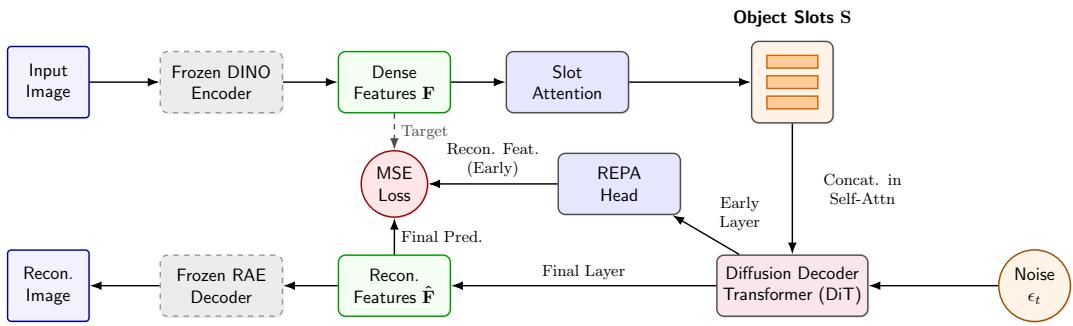
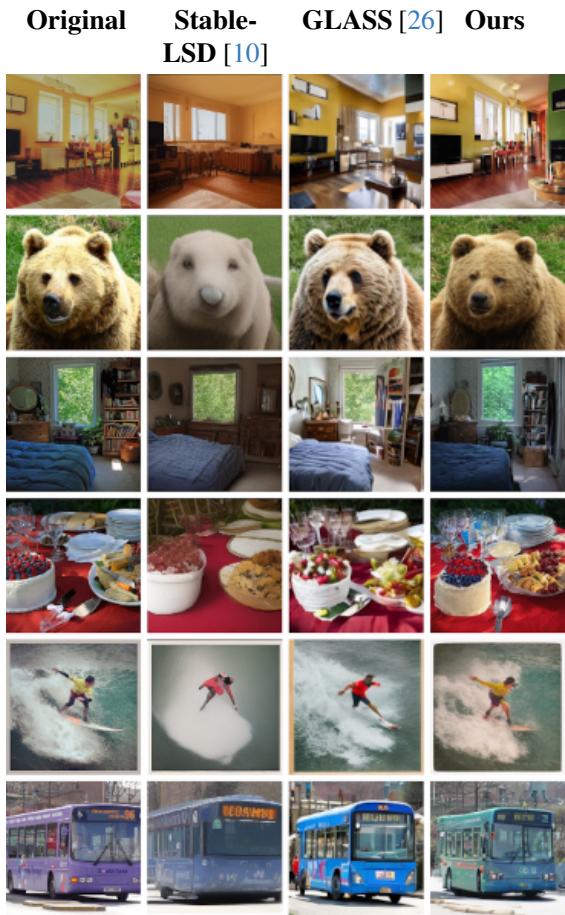
Figureure 1 · Overview of the Slot-RAE ArchitectureFigure 1. Overview of the Slot-RAE Architecture. The framework processes inputs via a frozen DINO encoder (top row) to extract dense features, which are then compressed into discrete slots via Slot Attention. The generative process (bottom row) diffuses within the continuous DINO feature space utilizing a DiT. The slots condition the diffusion via concatenation in the self-attention sequence alongside noisy tokens. Both the final DiT layer and the REPA head (branching from an early layer) extract reconstructed features supervised by the target. Finally, an optional, frozen RAE decoder enables zero-shot visualization and latent composition in the pixel space.这张图概括 Slot-RAE 的整体方法流程。阅读时先看模块之间传递的训练信号,再看作者如何把目标拆成可优化的子问题。Figureure 3 · Qualitative image reconstruction comparison across different object-ceFigure 3. Qualitative image reconstruction comparison across different object-centric models. From left to right: original image, Stable-LSD [10], GLASS [26], and Slot-RAE (ours). The examples span diverse domains including indoor environments, animals, food arrangements, sports scenes, and vehicles.这张图/表用于判断 Slot-RAE 的实验收益来自哪里。重点看替换、消融或跨模型设置下趋势是否一致,而不是只看单个最高分。
核心问题
它和通用视觉自监督的关系在于:把 object-centric learning 直接放到冻结 VFM 语义特征空间和 DiT 解码里,贴近 DINO/RAE/无监督对象发现主线。
方法拆解
把 object-centric learning 直接放到冻结 VFM 语义特征空间和 DiT 解码里,贴近 DINO/RAE/无监督对象发现主线