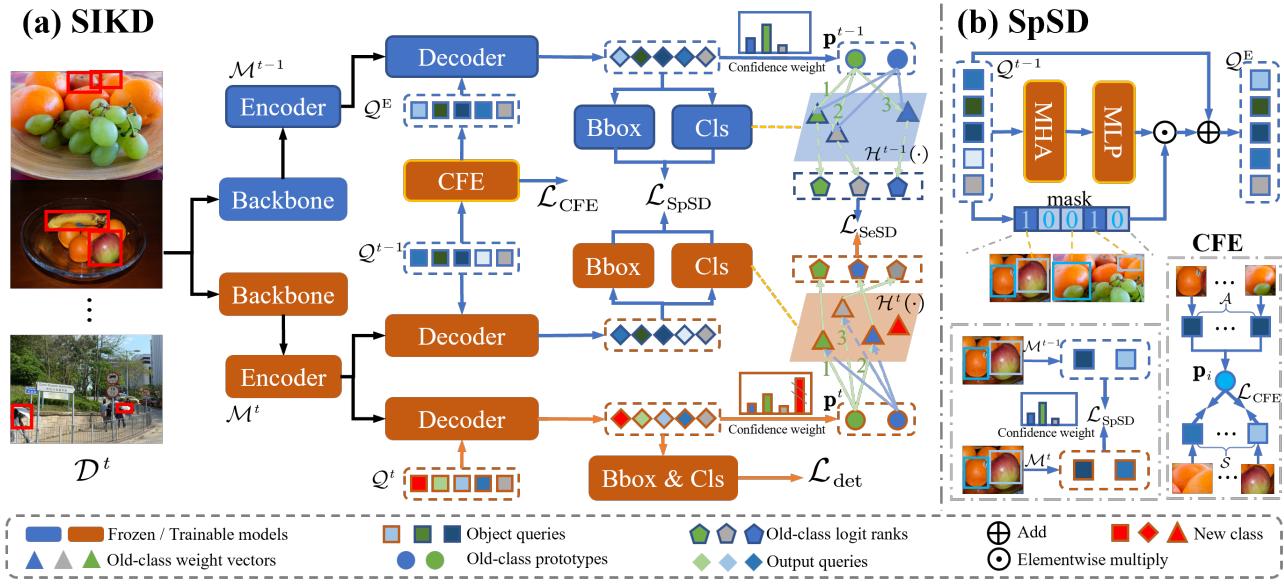
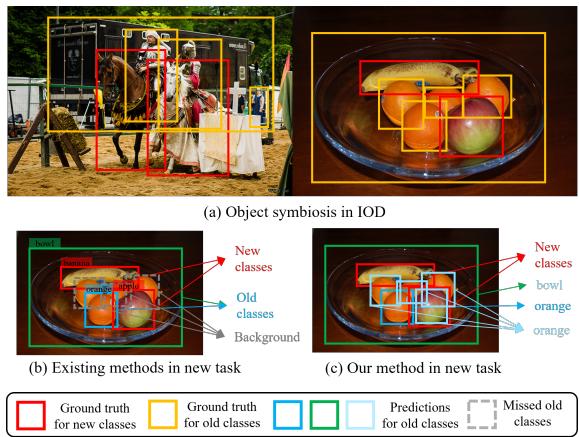
Figureure 3 · Overview of our proposed SIKDFigure 3. Overview of our proposed SIKD. (a) Training pipeline. The frozen old model $\mathcal { M } ^ { t - 1 }$ produces queries $\nsubseteq { \tau } ^ { t - 1 }$ on $\mathcal { D } ^ { t }$ . CFE refines queries of symbiotic regions under anchor-prototype guidance, yielding ${ \mathcal { Q } } ^ { \mathrm { E } }$ that reduces old-class bias and removes redundancy. SpSD distills anchor logits and boxes, which enforces confidence-weighted, layer-wise logit consistency over all queries. SeSD builds confidence-weighted, $L _ { 2 } .$ -normalized old-class prototypes from the last decoder layer of both models and aligns their classifier ranks to preserve the topology of old classes. (b) SpSD module. CFE contains multi-head self-attention (MHA) and an MLP, which is optimized with a prototype-guided cosine loss $\mathcal { L } _ { \mathrm { C F E } }$ on ${ \mathcal { Q } } ^ { \mathrm { E } }$ , and is discarded at inference.这张图概括 Symbiosis-Inspired Knowledge Distillation for Incremental 的整体方法流程。阅读时先看模块之间传递的训练信号,再看作者如何把目标拆成可优化的子问题。Figureure 1 · Illustration of (a) object symbiosis in IOD, (b) existing methods in nFigure 1. Illustration of (a) object symbiosis in IOD, (b) existing methods in new task, and (c) our method in new task. In (b) and (c), arrows indicate how regional features are classified. In (c), the new-task class apple shares coarse features with the old class orange while also retaining class-specific cues.这张图来自论文 PDF 的结构化抽取。当前用于辅助理解 Symbiosis-Inspired Knowledge Distillation for Incremental 的方法或实验,请结合正文精读段落一起看。