先说结论。它和通用视觉自监督的关系在于:在线判断新样本属于已知类还是应生成新类,和开放世界表征聚类/novel class discovery 相关。 中高相关;详见方法、贡献和实验边界。
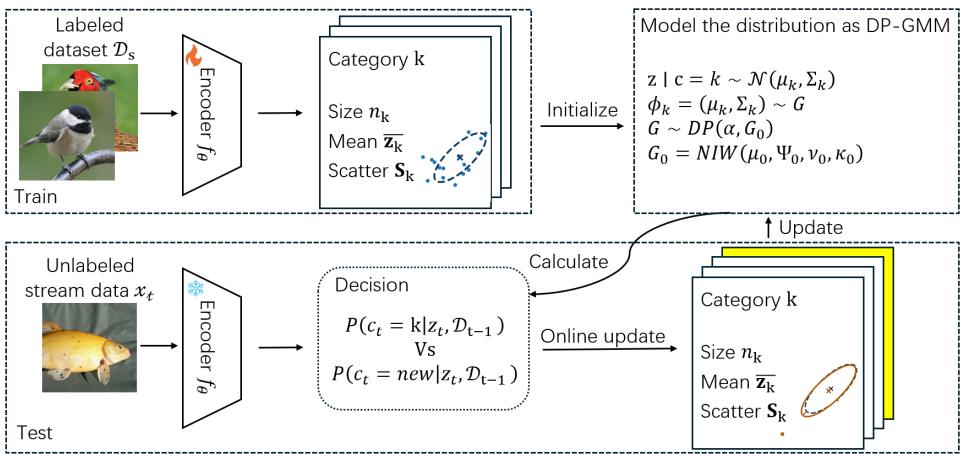
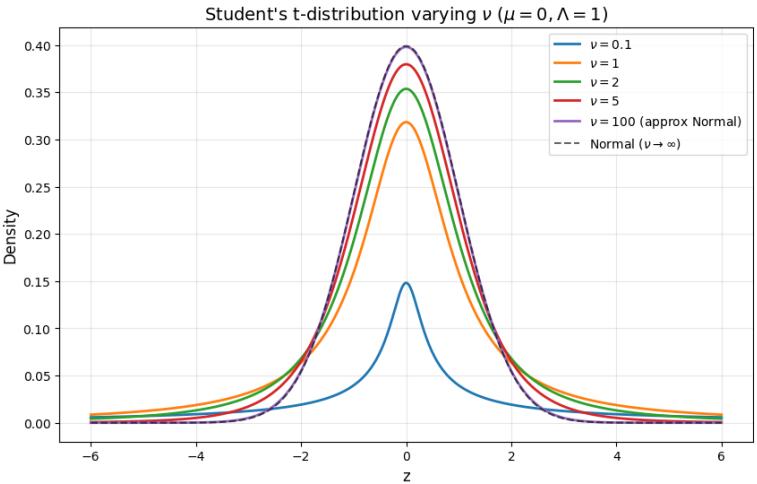
Figureure 1 · : Overview of our proposed DP-BOA frameworkFig. 1: Overview of our proposed DP-BOA framework. Our method consists of two phases. (Top) Ofline Initialization: We first train a feature encoder $f _ { \theta }$ on the labeled set $\mathcal { D } _ { S }$ . We then use the extracted features to compute the suficient statistics $\left( n _ { k } , \bar { \mathbf { z } } _ { k } , \mathbf { S } _ { k } \right)$ for all $K _ { S }$ known classes. These statistics are used to initialize our DP-GMM model (i.e., calibrate the global NIW hyperparameters from support-set statistics (Sec. 3.4)). (Bottom) Online Inference: At test time, a new sample x<sub>t</sub> is passed through the frozen $f _ { \theta }$ . Our model performs a posterior-predictive birth-or-assign decision $\left( \mathrm { E q . ~ } \left( 1 2 \right) \right)$ , comparing the posterior probability of assigning z<sub>t</sub> to an existing category $( { \cal P } ( c _ { t } = k | . . . ) )$ versus birthing a new category $( P ( c _ { t } = \mathrm { n e w } | . . . ) )$ . Based on this decision, the statistics of the corresponding category are updated online.这张图概括 DP-BOA 的整体方法流程。阅读时先看模块之间传递的训练信号,再看作者如何把目标拆成可优化的子问题。Figureure 3 · : One-dimensional Student-t densities $t _ { 1 } ( z \mid \mu , \lambdFig. 3: One-dimensional Student-t densities $t _ { 1 } ( z \mid \mu , \lambda , \nu )$ with $\mu { = } 0$ and $\varLambda { = } 1$ for diferent degrees of freedom $\nu \in \{ 0 . 1 , 1 , 2 , 5 , 1 0 0 \}$ , together with the standard normal $\mathcal { N } ( 0 , 1 )$ (dashed) corresponding to the limit $\nu \to \infty$ . As \nu increases, the distribution becomes more concentrated around $\mu$ and its tails become lighter, eventually matching the Gaussian shape.这张图来自论文 PDF 的结构化抽取。当前用于辅助理解 DP-BOA 的方法或实验,请结合正文精读段落一起看。
核心问题
它和通用视觉自监督的关系在于:在线判断新样本属于已知类还是应生成新类,和开放世界表征聚类/novel class discovery 相关。
方法拆解
在线判断新样本属于已知类还是应生成新类,和开放世界表征聚类/novel class discovery 相关