先说结论。它和通用视觉自监督的关系在于:把 CLIP embedding space 解释为 hyperspherical semantic mixture,而不是高斯空间。 高相关;详见方法、贡献和实验边界。
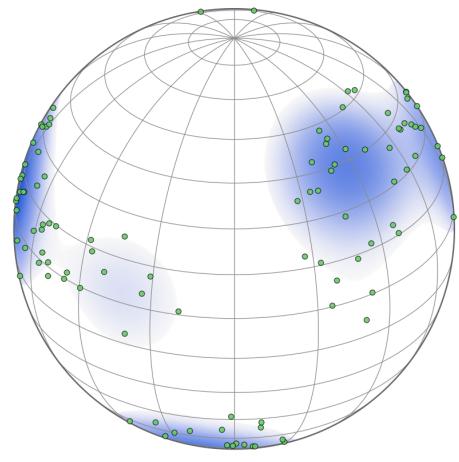
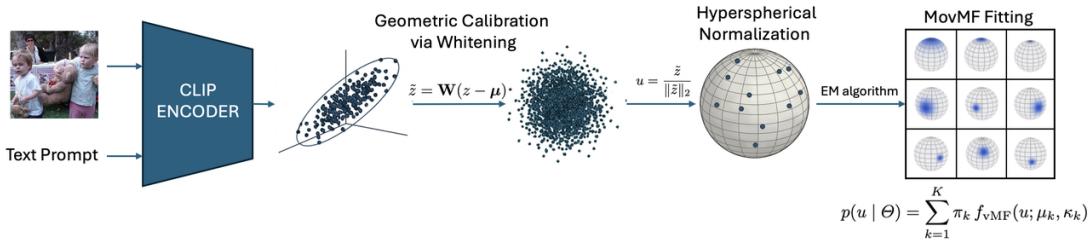
(b) MovMF-CLIP on <sup>Sd−1</sup> Figure 1: Density modeling of CLIP latent space (visuali(b) MovMF-CLIP on <sup>Sd−1</sup> Figure 1: Density modeling of CLIP latent space (visualized via dimensionality reduction on real data). (a) Gaussian-based approaches such as W-CLIP model the latent space with a single global distribution, which can assign low likelihood to valid long-tail concepts due to their distance from the global mean. (b) MovMF-CLIP models the space as a hyperspherical semantic mixture, capturing the multimodal structures and providing density estimates aligned with semantic clusters.这张图来自论文 PDF 的结构化抽取。当前用于辅助理解 The Hyperspherical Geometry of CLIP 的方法或实验,请结合正文精读段落一起看。Figureure 2 · : Overview of the MovMF-CLIP FrameworkFigure 2: Overview of the MovMF-CLIP Framework. We first extract raw embeddings using the CLIP encoder, which exhibit severe anisotropy. To address this, we apply geometric calibration via whitening $( \tilde { z } = \mathbf { W } ( z - \pmb { \mu } ) )$ and normalize the features onto a unit hypersphere $( u = \tilde { z } / \| \tilde { z } \| _ { 2 } )$ Finally, we fit a MovMF distributions on the hypersphere using the EM algorithm, yielding a principled multimodal density model.这张图概括 The Hyperspherical Geometry of CLIP 的整体方法流程。阅读时先看模块之间传递的训练信号,再看作者如何把目标拆成可优化的子问题。
核心问题
它和通用视觉自监督的关系在于:把 CLIP embedding space 解释为 hyperspherical semantic mixture,而不是高斯空间。
方法拆解
把 CLIP embedding space 解释为 hyperspherical semantic mixture,而不是高斯空间