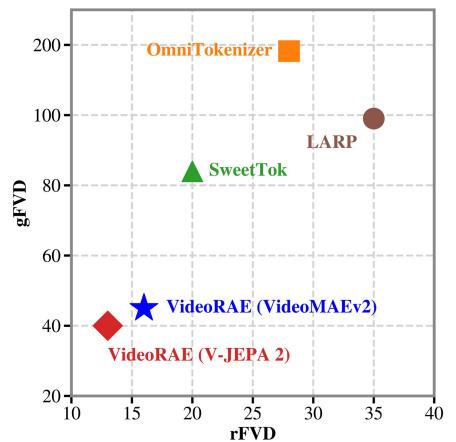
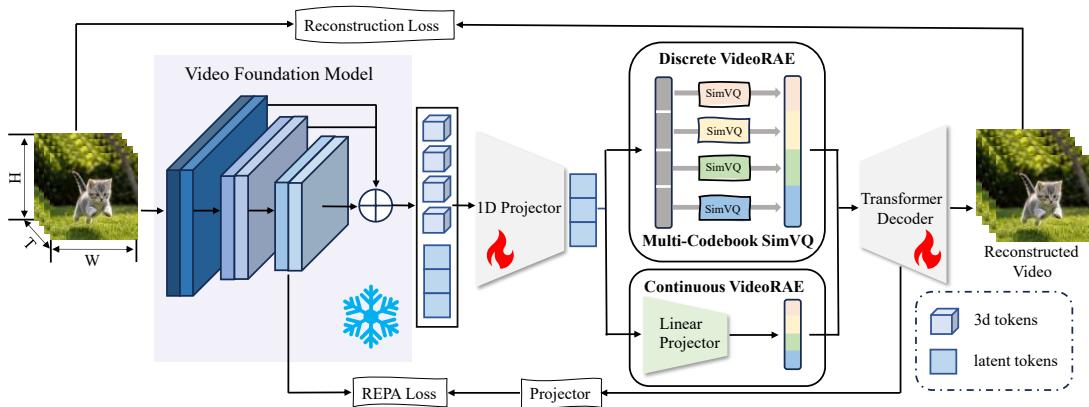
(c) Video reconstruction and generation on UCF-101 dataset Figure 1: Conceptual comparison(c) Video reconstruction and generation on UCF-101 dataset Figure 1: Conceptual comparison between traditional video tokenizers and VideoRAE. Traditional 3D-VAEs are trained from scratch and driven solely by pixel-level MSE and adversarial losses. In contrast, VideoRAE directly utilizes a frozen video foundation model as its core feature extractor. VideoRAE provides a unified and semantically rich latent space that perfectly supports both continuous and discrete generative paradigms, achieving high-fidelity reconstruction and high-quality generation.这张图/表用于判断 VideoRAE 的实验收益来自哪里。重点看替换、消融或跨模型设置下趋势是否一致,而不是只看单个最高分。Figureure 2 · : Overall architecture of VideoRAEFigure 2: Overall architecture of VideoRAE. Given an input video, multi-scale hierarchical features are first extracted from a frozen VFM and fused, followed by a 1D self-attention projector that dynamically compresses them into compact base tokens. These tokens are then formatted into either a continuous latent space via linear projection for Diffusion Transformers, or a discrete latent space via Multi-Codebook SimVQ for Autoregressive models. Finally, during decoding, the Representation Alignment module explicitly aligns intermediate decoder features with the VFM teacher at both local and global scales, intrinsically regularizing the semantic structure of the latent manifold.这张图概括 VideoRAE 的整体方法流程。阅读时先看模块之间传递的训练信号,再看作者如何把目标拆成可优化的子问题。