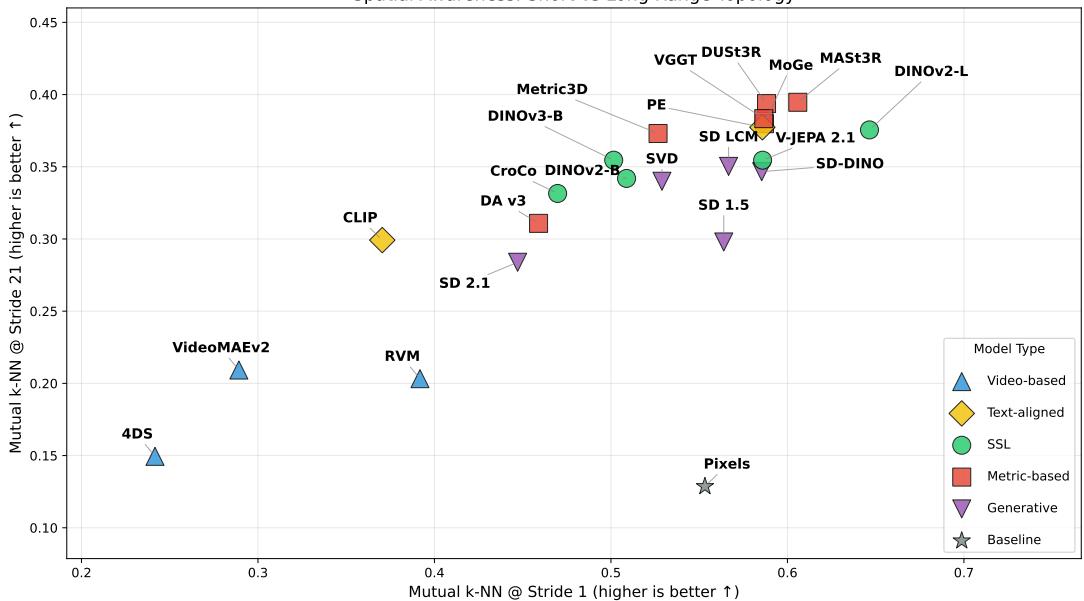
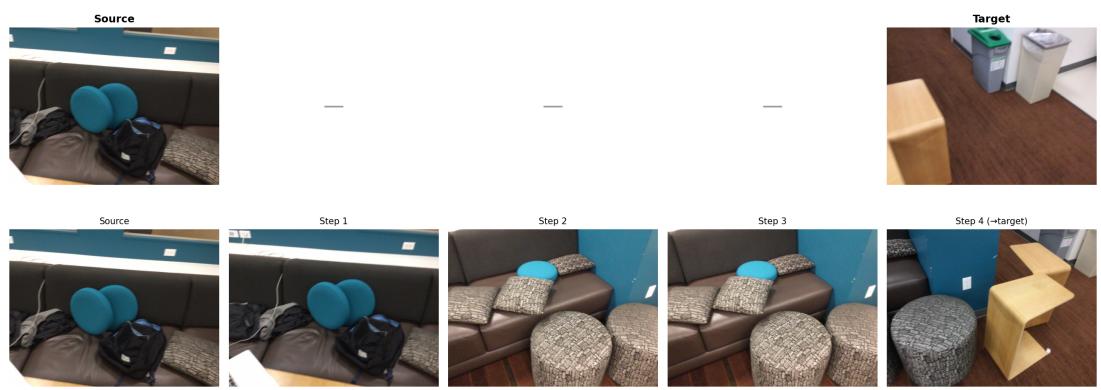
Figureure 2 · : Mutual k-nn Alignment (M1)Figure 2: Mutual k-nn Alignment (M1). Alignment between camera poses and vision features for short (x axis) and long (y axis) strides on ScanNet. The former captures pixel-level dependencies, while the latter is more indicative of spatial awareness. Explicit geometric models (DUSt3R, MoGe) achieve high alignment. Among self-supervised models, DINO-family encoders show emergent spatial topology, while video models (4DS, RVM) struggle to maintain a consistent spatial embedding.这张图来自论文 PDF 的结构化抽取。当前用于辅助理解 SeeSE3 的方法或实验,请结合正文精读段落一起看。Trajectory 4: Δtrans=2.45m, ∆rot=0.65rad|Final error: 1.020m / 0.084rad Figure 12: TrajectTrajectory 4: Δtrans=2.45m, ∆rot=0.65rad|Final error: 1.020m / 0.084rad Figure 12: Trajectory 3 (Extreme Displacement). $\Delta P \ : = \ : 2 . 4 5 \mathrm { m } , 3 7 ^ { \circ }$ rotation. The largest displacement tests the limits of the open-loop linear model. While translation error accumulates, the rotation is extremely well recovered (0.084rad ≈ 5<sup>◦</sup>). (Final error: 1.020m, 0.084rad).这张图来自论文 PDF 的结构化抽取。当前用于辅助理解 SeeSE3 的方法或实验,请结合正文精读段落一起看。