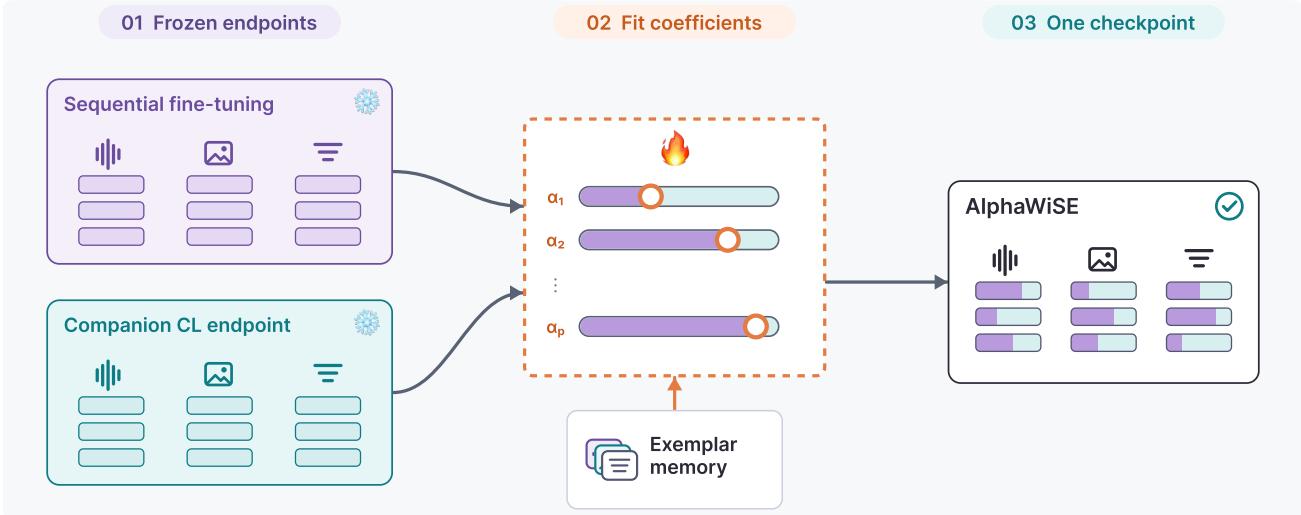
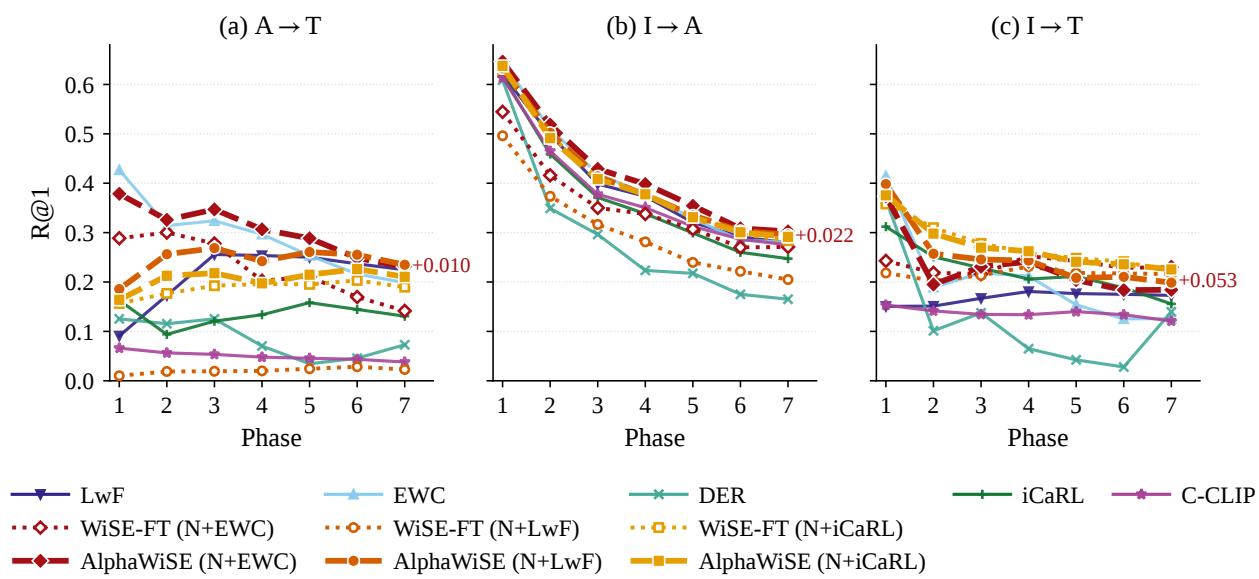
Figureure 1 · : AlphaWiSE performs post-hoc, per-tensor fusion of two compatible conFigure 1: AlphaWiSE performs post-hoc, per-tensor fusion of two compatible continual-learning checkpoints. Both source checkpoints remain frozen. The exemplar memory is used only to optimize the coeficients $\beta ,$ with $\alpha _ { p } = \sigma ( \beta _ { p } )$ and $\tilde { \theta } _ { p } = \alpha _ { p } \theta _ { p } ^ { \mathrm { u n } } + ( 1 - \alpha _ { p } ) \theta _ { p } ^ { \mathrm { r e g } }$ . After optimization, the fused tensors are materialized into one checkpoint. The final model has the same architecture and inference-time computation as either source checkpoint.这张图概括 AlphaWiSE 的整体方法流程。阅读时先看模块之间传递的训练信号,再看作者如何把目标拆成可优化的子问题。Figureure 2 · : Phase-wise R@1 for the listed continual-learning and AlphaWiSE confiFigure 2: Phase-wise R@1 for the listed continual-learning and AlphaWiSE configurations. Results are shown over phases 1–7 for audio-to-text (A→T), image-to-audio (I→A), and image-to-text (I→T) retrieval on the 79-class candidate pool. Thin solid lines denote the listed non-fusion baselines, and thick dashed lines denote the three AlphaWiSE pairings. At phase 7, the best AlphaWiSE pairing is numerically higher than the strongest listed non-fusion baseline by 0.0101 R@1 for A→T, 0.0216 for I→A, and 0.0526 for I→T.这张图/表用于判断 AlphaWiSE 的实验收益来自哪里。重点看替换、消融或跨模型设置下趋势是否一致,而不是只看单个最高分。