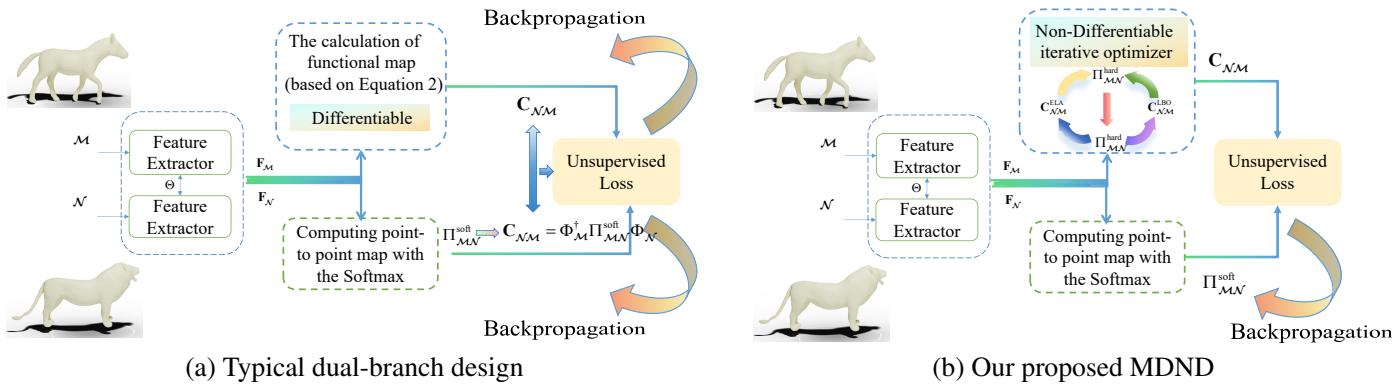
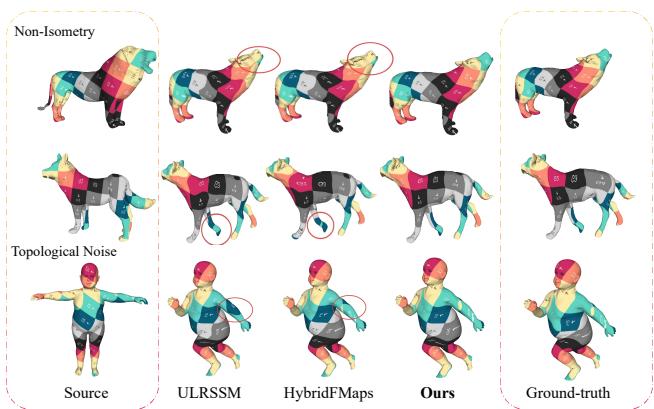
Figureure 2 · : A comparison of deep functional map architecturesFigure 2: A comparison of deep functional map architectures. (a) The conventional dual-branch framework which is fully differentiable and thus limited to differentiable solvers. (b) Our proposed MDND framework, which introduces a paradigm shift by incorporating a non-differentiable iterative refinement oracle. This oracle generates a high-quality target map, while gradients for training the feature extractor propagate exclusively through the parallel, differentiable branch. This design decouples refinement from learning and avoids potential gradient conflicts.这张图概括 MDND 的整体方法流程。阅读时先看模块之间传递的训练信号,再看作者如何把目标拆成可优化的子问题。Figureure 1 · : Qualitative comparison on challenging shapesFigure 1: Qualitative comparison on challenging shapes. We visualize correspondences via texture transfer, comparing our method against state-of-the-art approaches like ULRSSM (Cao, Roetzer, and Bernard 2023) and HybridFMaps (Bastian et al. 2024). Our method produces noticeably more accurate and coherent maps in challenging scenarios involving non-isometric deformations (top rows) and significant topological noise (bottom row).这张图/表用于判断 MDND 的实验收益来自哪里。重点看替换、消融或跨模型设置下趋势是否一致,而不是只看单个最高分。